AI Tutors in Higher Education: Help, Hype, or Shortcut?
Search interest in AI tutors has never been higher. Students look for an AI tutor app for calculus the night before an exam, parents compare AI language tutors for their kids, and institutions evaluate platform offerings with tutor features. Behind all of it sits one question that rarely gets asked directly: what should an AI tutor actually do?
Two very different products share one name
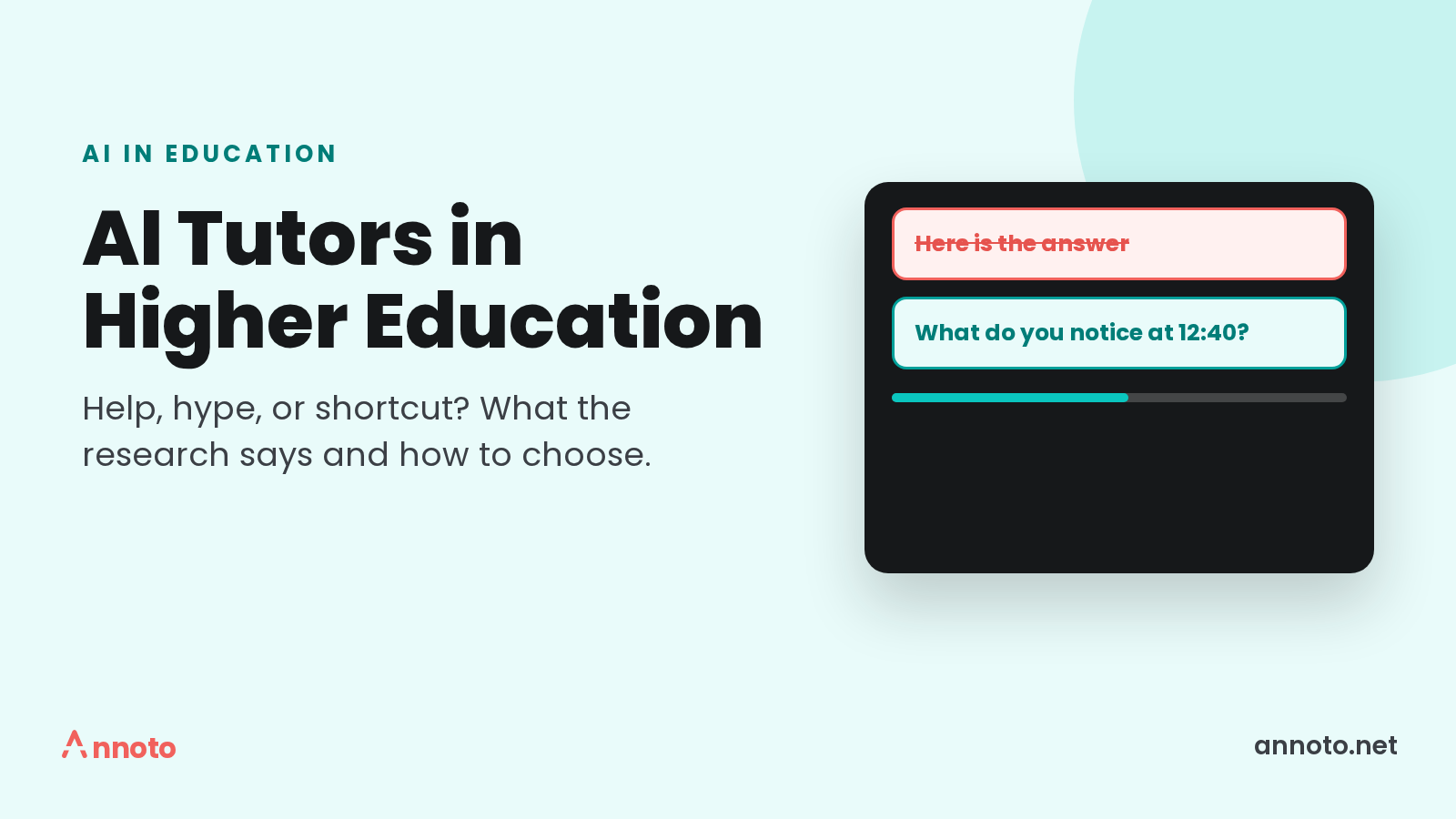
Most tools marketed as AI tutors are answer engines. Paste the question, receive the solution, move on. They are genuinely impressive, and for a student under deadline pressure they feel like help. The second, much rarer kind behaves like a human tutor: it asks what you tried, points you back to the material, and gives you the next question rather than the final answer.
The distinction matters because the two products produce opposite outcomes. An answer engine optimizes for completing the task. A tutor optimizes for the learner being able to complete the next task alone. Everything else in this article follows from that difference.
What the 2026 research actually says
Two findings landed this fall that every evaluation should absorb. A randomized study from researchers at UC Berkeley, Carnegie Mellon, MIT, Oxford and UCLA gave 1,222 participants problem sets with and without AI assistance. The assisted group scored higher at first. When the tool was removed, their accuracy dropped sharply and they gave up on hard problems sooner than people who had worked unaided all along. The authors describe the effect as a loss of productive struggle.
Around the same time, Australia's national education research body AERO warned schools about cognitive outsourcing: students who rely on a general chatbot can look capable while it is open and struggle once it is closed, because the thinking happened in the tool rather than in the student. AERO's recommendation was not a ban. It was to prefer purpose built tools that guide students through reasoning rather than giving direct answers.
Neither finding says AI tutoring is bad. Both say the design of the tutor decides whether it builds capability or borrows it.
The context problem nobody mentions in the demo
There is a second gap that matters just as much in a course setting: generic tutors have never seen your course. They answer from the open internet, in notation your students have not learned, sometimes contradicting the instructor, and occasionally inventing facts with full confidence. The student cannot tell the difference, which is precisely the problem.
A course grounded tutor works from the actual lecture. When a student asks a question at minute 14 of a recorded class, it can answer from what the instructor said at minute 9, point back to the exact timestamp, and stay inside the course vocabulary. That is the approach we took with Lumo, Annoto's in video assistant, and the design principle generalizes to any tool you evaluate: the tutor should know the course better than the student does, not merely know more than the student does.
A practical checklist for choosing an AI tutor
When you evaluate a tool, run it through five questions.
Does it guide or does it solve? Give it a homework style question and watch. A tutor worth having responds with a scaffold: a hint, a pointer to the material, a smaller question. If the first response is the full solution, you are buying an answer engine.
Is it grounded in your course? Ask it something your instructor explained in a nonstandard way. A grounded tutor answers in the course's terms and can point to where. A generic one answers from the internet and drifts.
Can instructors see the questions? Student questions are the richest formative signal a course produces. If the tutor swallows them privately, the instructor loses a live map of what the cohort finds confusing. The best implementations surface question clusters by topic and by minute of video, the same way comprehension checks surface understanding.
Does it protect the struggle? Look for friction by design: the tutor asks the student to attempt first, reveals progressively, and declines to do assessed work. This is the feature the Berkeley findings argue for, and it is the first feature answer engines remove.
Does it leave evidence of learning? Interactions should accumulate into something an instructor can act on, in the spirit of engagement analytics, not vanish into a private chat history.
Takeaways for educators
Treat the phrase AI tutor with precision: the market sells two opposite products under one name. Prefer tutors that question back over tutors that answer first. Prefer tools grounded in your own course material over tools that answer from everywhere and nowhere. Insist on instructor visibility, because a tutor that hides the questions hides the teaching opportunity. And keep the research in view: assistance that removes the struggle also removes the learning, so the right tutor is the one that makes students do the brain work with better support, not the one that does it for them. For a wider view of where AI genuinely helps teaching today, see our guide to what actually helps in 2026.