Meet Lumo: AI That Turns Video Into a Conversation

The 2026 AI reality check: capability is up, trust is the bottleneck
The story about AI in education has shifted. A year ago the open question was whether the models were good enough to help students learn. Now they clearly are, and the bottleneck has moved. The 2026 EDUCAUSE Horizon Report, Teaching and Learning Edition, frames the central issue not as capability but as a growing challenge of trust and credibility as AI becomes embedded in coursework.

The report describes a specific tension. Students increasingly turn to AI chatbots for explanations before they ask an instructor, while faculty face real uncertainty about how much of a student's work was generated by a machine. Because humans are poor at reliably identifying AI-generated output, that uncertainty curdles into friction: students feel unfairly doubted, instructors feel unable to trust what they are grading, and the relationship becomes more transactional. EDUCAUSE's recommendation is not to ban the tools but to set clear norms and to invest in the human elements technology cannot replace, including mentoring, judgment, and designs centered on trust and belonging.
That is the design problem Lumo is built to solve. AI adds value in video learning when it is tethered to the actual content, keeps the instructor in the loop, and supports a student's thinking instead of doing it for them.
Why do generic chatbots miss in a course?
A general-purpose chatbot is impressive and, for coursework, structurally wrong in three ways.
- No grounding. It answers from a broad training distribution, not from the specific lecture, reading, or framing your course uses. It can be confidently off-syllabus, and its reasoning and sources are opaque, which is precisely the credibility gap the Horizon Report warns about.
- No context. It does not know what the student just watched, what the class is discussing, or where this student got stuck. So its help is generic when the learning need is specific.
- No oversight. The instructor has no visibility into what was asked or answered, which makes it impossible to catch a misconception spreading through the class or to intervene when a student is offloading rather than learning.
Strip those three problems away and you get a very different kind of assistant.
How Lumo works inside the video
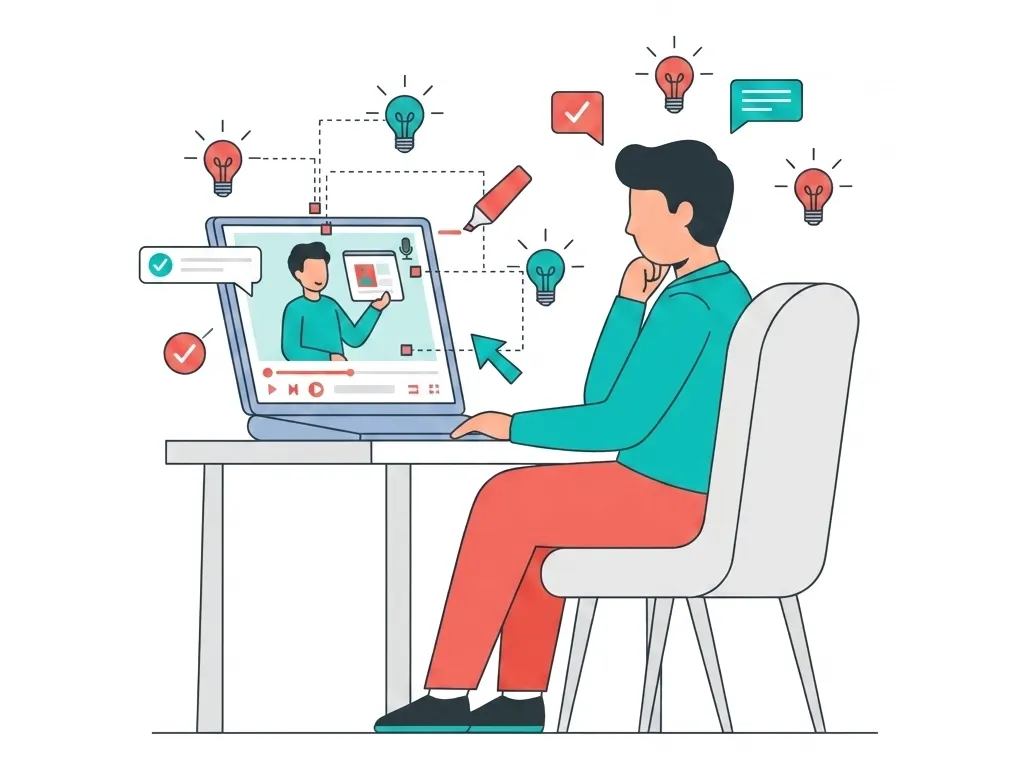
Lumo lives inside the video and is grounded in it. When a student asks a question, the answer is drawn from the content of that video and the discussion happening around it on the timeline, not from an open-ended guess. That changes what the assistant is good for:
- Grounded answers. A student stuck at a specific moment can ask what a term means or why a step follows, and get an explanation tied to what was actually said, at the point it was said.
- Summaries and recall prompts. Lumo can condense a segment or generate a quick self-check, giving students the retrieval practice that makes learning stick rather than a passive re-watch.
- Prompts tied to the timeline. Because the assistant knows where the student is in the video, it can nudge reflection at the moments that matter instead of in the abstract.
The effect is to keep the conversation about the course material rather than about the internet at large. That grounding is what turns an AI feature from a credibility risk into a comprehension aid.
Feedback at scale without losing the human
One of the most promising, and least controversial, uses of AI in higher education is helping instructors and teaching assistants give more and faster feedback. Feedback is discretionary work: valuable, time-consuming, and the first thing to get squeezed when a course scales. Recent research on AI assistance for discretionary work in higher education examines exactly this, looking at whether AI support increases the feedback students receive.
The framing that matters here is TA plus AI, not AI only. AI can draft, surface the questions that keep recurring, and flag where a cohort is confused, while the human decides what is right, adds the judgment, and owns the relationship. Studies evaluating AI-powered learning assistants in engineering education are part of a growing evidence base testing where these tools genuinely help and where they fall short. The consistent lesson is that AI is a force multiplier for human feedback, not a replacement for it, which is also what keeps trust intact.
Guardrails that keep students thinking
The risk with any capable assistant is that it becomes a shortcut around the thinking that produces learning. The design goal, then, is to make Lumo support generation rather than substitute for it. In practice that means favoring answers that explain and prompt over answers that simply hand over a finished response, tying help to the specific content so students stay engaged with the material, and keeping the assistant's activity visible to instructors rather than hidden in a private chat.
Data handling belongs in the same conversation. Grounded, in-course AI should operate within the institution's privacy and security posture, scoped to the course context and transparent about what it processes. Trust is not only about the quality of an answer. It is about students and faculty knowing how the system behaves with their data.
Where AI helps, and where it should not be trusted
It is worth being direct about the boundaries. AI grounded in the video helps with comprehension, with keeping momentum through a hard segment, with low-stakes self-testing, and with expanding the feedback a stretched teaching team can provide. It should not be trusted as the final arbiter of correctness on high-stakes work, as a stand-in for instructor judgment, or as an unsupervised authority whose reasoning nobody can inspect. The Horizon Report's caution about credibility applies with full force to anything a student will be graded on.
Used inside those boundaries, AI stops being a threat to academic integrity and starts being an ordinary part of a well-designed course, closer to a good teaching assistant than to a magic answer box.
Rolling out AI responsibly in your courses
A responsible rollout looks less like a launch and more like a pilot.
- Start with one course and set explicit norms with students about what AI help is for, in line with EDUCAUSE's advice to establish clear expectations.
- Turn on grounded, in-video assistance so help stays tied to your content rather than the open web.
- Keep instructors and TAs in the loop, using AI to widen feedback while humans own judgment and relationships.
- Watch the engagement and question analytics to see where students actually get stuck, and let that reshape the video and the prompts.
- Review data handling against your institution's requirements before you scale beyond the pilot.
Capability is no longer the hard part. Trust is. An assistant that stays grounded in the video, keeps the instructor present, and helps students think rather than skip thinking is how you add AI to video coursework without spending the credibility you cannot easily get back.
Keep reading
Related: Turn Passive Video Into an Active Workspace, WashU: Time-Tagged Feedback On Student Sign-Language Videos, and In-Video Quizzes: Turning Passive Watching Into Active Recall.
New to Annoto? Start with What is Annoto?, or see it inside your LMS: Canvas, Moodle, Blackboard, and Brightspace.