AI in Teaching: What Actually Helps in 2026 (and What's Just Hype)

Every faculty meeting in 2026 seems to circle back to the same question: is AI actually making teaching better, or are we just adding tools for the sake of it? The honest answer is both. Used well, AI removes drudgery and helps instructors see their students more clearly. Used carelessly, it manufactures confident-sounding content that nobody checked. The difference is not the model. It is the workflow around it.

Where AI genuinely helps
The most durable wins are the unglamorous ones. Drafting formative questions is a good example. Writing a well-targeted comprehension check for every segment of a lecture is time-consuming, and the fatigue shows by question twenty. AI can propose a first draft in seconds, letting the instructor spend their energy judging quality rather than generating from a blank page.
It also helps with structure. Ask a copilot to map a set of questions to Bloom's taxonomy and you get a quick audit of whether your assessment leans entirely on recall or actually reaches analysis and evaluation. That prompt to climb the cognitive ladder is often the single most useful nudge an instructor gets all week.
The human stays in the loop
None of this works if the machine gets the last word. The reliable pattern is human-in-the-loop: AI drafts, the educator reviews, edits, and approves before anything reaches a student. This is not a compliance formality. Instructors know their cohort, their misconceptions, and the phrasing that will land. A generated question is a starting point, not a verdict.
- Let AI generate options; keep approval with the instructor.
- Treat every draft as editable, never final.
- Anchor questions to your own learning objectives, not the model's guess at them.
- Spot-check factual claims before they become graded content.
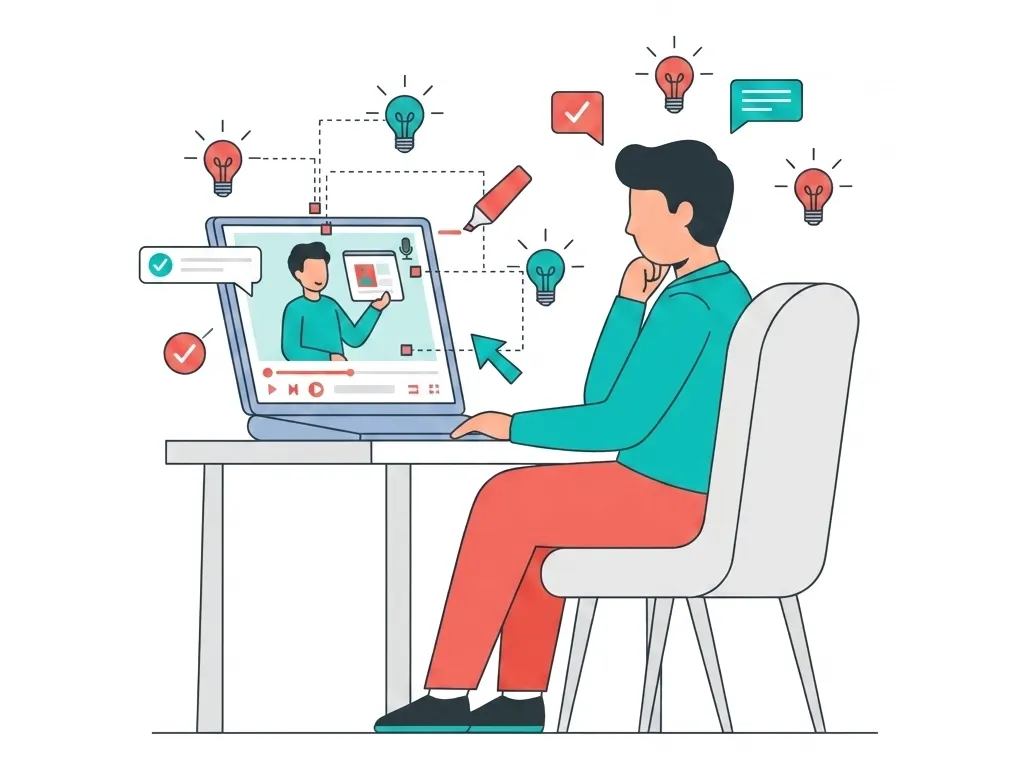
Annoto's Lumo copilot is built around exactly this posture. It suggests in-video quiz questions and discussion prompts tied to the moment on screen, but the educator curates what actually goes live. The AI compresses prep time; the teacher keeps authorship.
Surfacing who's struggling
The other genuinely useful application is diagnostic. When learners answer in-video questions and leave comments, patterns emerge: a concept where half the cohort stumbles, a segment everyone rewinds, a question that quietly divides the room. AI can help summarize that signal so an instructor walks into class already knowing where to spend the next fifteen minutes. That is teaching intelligence, not automation.
What's mostly hype
Be skeptical of anything that promises to replace the instructor's judgment. Fully automated grading of nuanced work, AI that claims to measure understanding without a human reading the responses, and one-click course generation all tend to produce output that looks finished but is shallow on inspection. The pedagogy still has to come from a person.
The takeaway for 2026 is calm rather than breathless. AI is a capable assistant for drafting, structuring, and surfacing. It is a poor substitute for a teacher's judgment. Keep the human in the loop, use tools like Lumo to buy back prep time, and spend that time where machines cannot help: with your students.
How to evaluate the next tool
When the next vendor demo arrives, three questions separate assistants from liabilities. Who approves the output? If generated content can reach students without an educator’s sign-off, the workflow is wrong no matter how capable the model. Does it work where you teach? Anything living outside the LMS adds logins and friction. And what evidence does it produce? Prefer tools that expose response data you can inspect over ones that hand down opaque scores.
Run any candidate through a one-course pilot before a wider rollout, then ask the instructors a blunt question: did this buy back time you then spent on students? If not, the tool failed the only test that matters.
Keep reading
Related: Nova Southeastern University: An Effective, Easy-To-Use Learning Tool, Georgia Tech: Guiding Questions For A Meaningful Learning Experience, and One Engagement Layer, Any LMS and Any Video Host.
New to Annoto? Start with What is Annoto?, or see it inside your LMS: Canvas, Moodle, Blackboard, and Brightspace.