AI Literacy for Students: The Skill Every Course Now Has to Teach
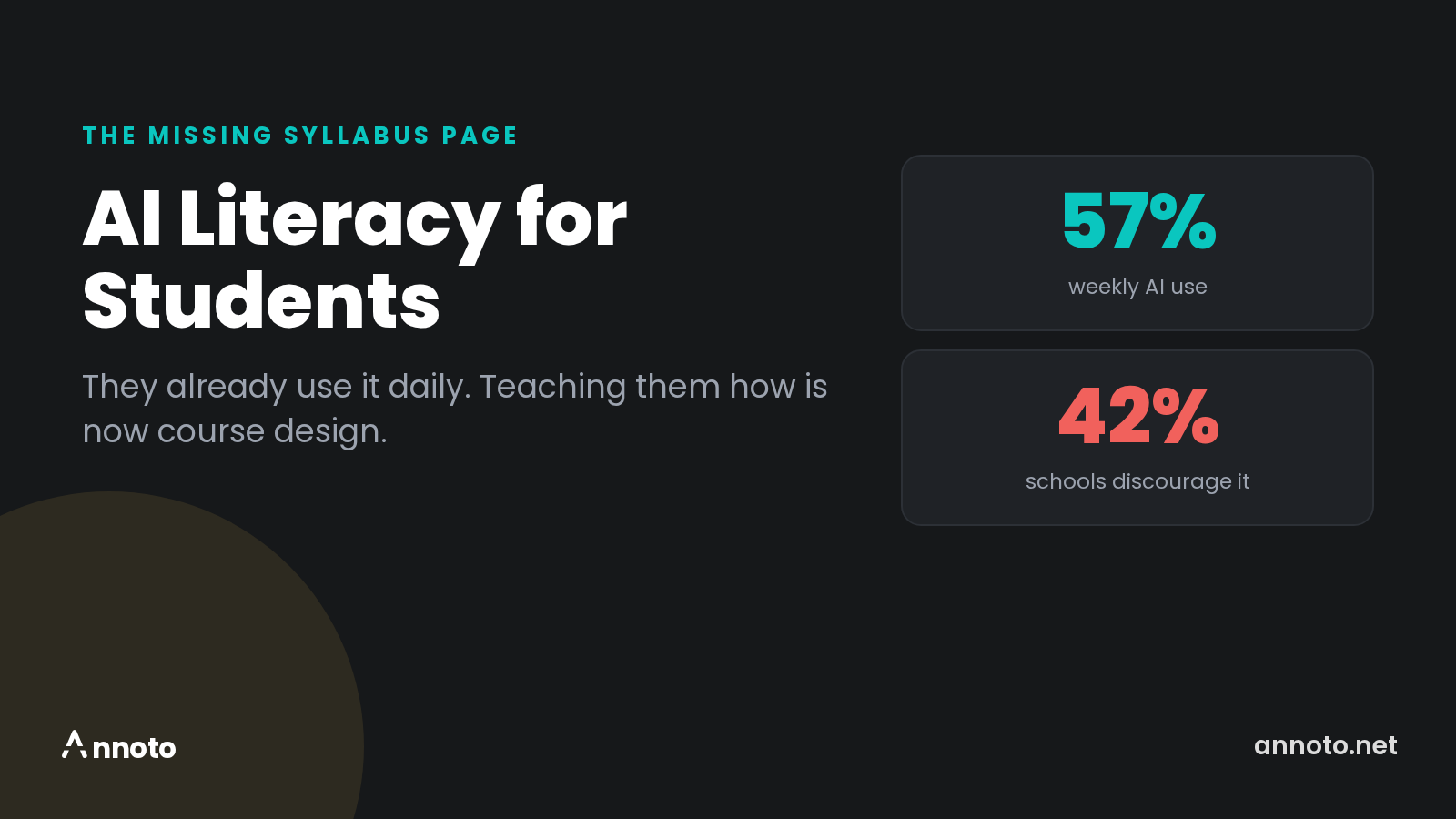
The Gallup and Lumina Foundation State of Higher Education study put numbers on what every instructor already suspected: 57 percent of college students use AI in their coursework at least weekly, and 21 percent use it daily. The same students report that their institutions have not caught up, with 42 percent saying their school discourages AI use and another 11 percent saying it is prohibited outright.
Read those numbers together and a strange picture emerges. The most consequential study tool to arrive in a generation is in daily use, and the dominant institutional response is to look away. Students are left to work out alone when the tool helps them learn and when it quietly replaces the learning. That judgment is a skill. Nobody is teaching it.
What AI literacy actually means
AI literacy is not prompt engineering, and it is not a lecture on how transformers work. For a student, it comes down to three judgments made in the moment. First, is this a task where AI should help at all, or is the struggle the point? Research from UC Berkeley and partner universities this fall showed that participants who leaned on AI for practice problems performed worse and gave up sooner once the tool was removed, so knowing when not to ask is a core part of the skill. Second, how do I verify what it told me? Models answer with equal confidence when they are right and when they are inventing a citation. Third, what do I owe my instructor and my classmates in disclosure?
Those three judgments, when to use, how to verify, what to disclose, are teachable in any discipline, and they transfer. A student who learns them in a biology course carries them into the workplace, which is where employers increasingly expect them.
Five moves that teach AI literacy inside an existing course
Publish a traffic light policy. Replace the vague integrity clause with three explicit zones. Green: AI is welcome, for brainstorming, clarifying a concept, quizzing yourself. Yellow: AI is allowed with disclosure, for drafting and refining, with prompts attached. Red: AI stays closed, for assessed reasoning, reflections, first attempts. Students follow rules they can actually picture.
Assign a verification exercise. Have students ask a chatbot about your course topic, then grade the answer against the source material. Nothing teaches healthy skepticism faster than catching a confident model inventing a reference. It also teaches the material twice.
Make the first attempt visible. The Berkeley findings argue for protecting the first unaided attempt, because that is where the learning concentrates. In video courses this is straightforward: in video questions at the moment a concept lands ask the student to answer before anything can be pasted anywhere, and the attempt is timestamped evidence of independent thinking.
Move discussion where disclosure is natural. When conversation happens on the video timeline, in front of classmates and anchored to a specific moment, students write in their own voice. Public, contextual contributions are far harder to outsource than a private essay, and they build the cohort while they do it.
Model it from the front. Show students how you use AI in your own preparation, where it saves you time, and where you caught it being wrong. Students calibrate on what instructors do, not on what policies say. Our overview of AI in teaching covers where the honest wins are.
Assessment has to move too
AI literacy teaching collapses if assessment still rewards polished product over visible process. If the graded artifact is a take home essay, the incentive to outsource is structural, whatever the syllabus says. Shifting weight toward process evidence, timestamped questions, in video checks, contributions to timeline discussion, peer feedback, aligns the incentives with the policy. We wrote about this shift in detail in Authentic Assessment in the AI Era.
Takeaways for educators
Students are not waiting for permission; they are already using AI at scale. The choice in front of every course team is whether that use stays unguided or becomes a taught skill. Publish zones instead of bans. Teach verification as a graded exercise. Protect the first attempt, in video courses with in player questions. Move discussion into contexts where honesty is the path of least resistance. And adjust assessment so the process counts, because the courses that do this now are not just managing a risk, they are teaching the single most transferable skill their students will take with them.