Authentic Assessment in the AI Era: Making Learning Visible
For decades the essay and the take home exam did two jobs at once: they made students think, and they produced evidence that the thinking happened. Generative AI quietly ended the second job. A polished five paragraph argument now proves only that someone, or something, can produce a polished five paragraph argument. Institutions have responded in two ways. One camp is racing to detect AI, a contest the detectors keep losing. The other is asking a better question, the one UNESCO and much of the EDUCAUSE 2026 conversation have put on the table: if the product no longer proves learning, how do we assess the process instead? That question has a name, authentic assessment, and video is turning out to be one of the most practical places to answer it.
Why the essay stopped being evidence
Assessment has always rested on an assumption: the artifact a student submits is a trace of work they did. Generative AI broke the link between artifact and effort. The failure is not that students cheat more than before. It is that instructors can no longer tell, from the artifact alone, what happened. Oral defenses and proctored exams restore certainty but do not scale, and they measure performance under pressure rather than learning over time. What scales is designing assessment so that the evidence accumulates while the learning happens, in a context a chatbot cannot inhabit: the specific lecture, the specific minute, the specific discussion with specific classmates.
What authentic assessment actually means
Authentic assessment is often reduced to "make it like the real world," but the research literature is more precise. Three properties matter. First, process visibility: the instructor can see how understanding developed, not only its final state. Second, contextual anchoring: the task is tied to material, moments, and discussions unique to this course, so a generic answer engine has nothing to grab onto. Third, dialogue: the student's thinking is probed and extended through interaction, which is also exactly what accreditors mean by regular and substantive interaction. None of this requires abandoning essays or exams. It requires surrounding them with evidence of process.
Video is where the process becomes visible
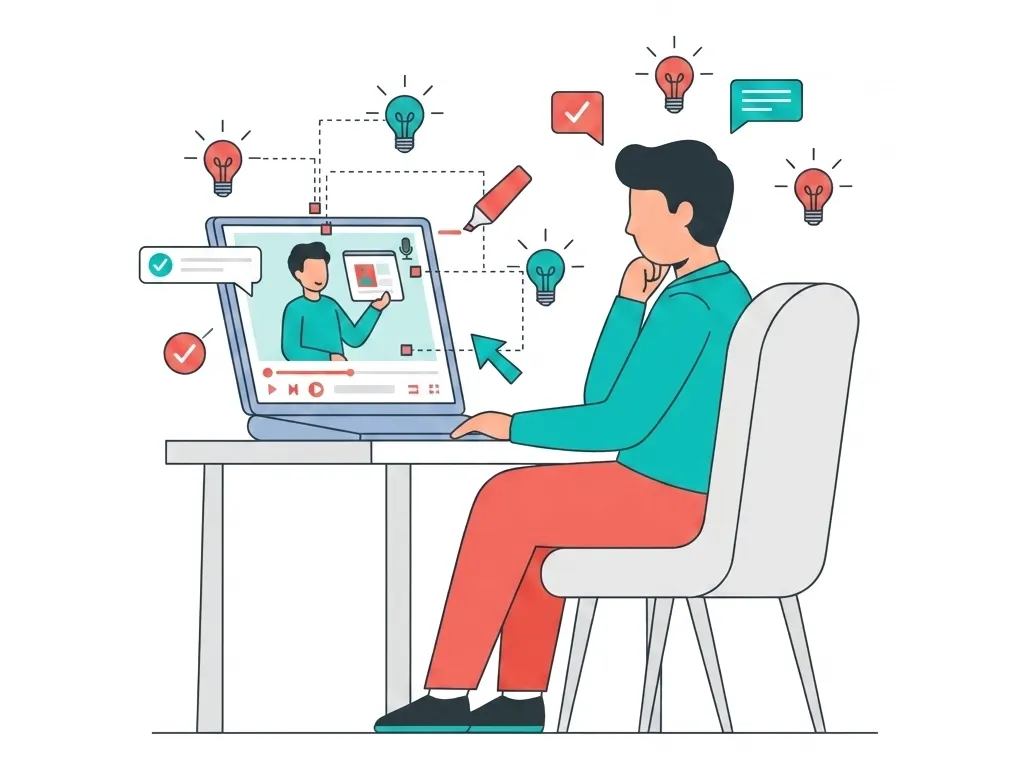
Most courses already run on video: lectures, demonstrations, case walkthroughs, student presentations. Watched passively, video produces the weakest evidence of all, a completion percentage. Made interactive, it produces the richest. When a student answers a comprehension question at minute 14, that answer is anchored to a moment and a concept. When she posts on the timeline that the presenter's assumption in minute 22 contradicts last week's reading, and a classmate pushes back two minutes later, that exchange is process made visible. It happened at a specific time, inside specific material, in a voice an instructor who reads the thread can recognize. This is what social learning on the video timeline looks like in practice, and it is remarkably hard to outsource.
Five moves educators can make this semester
1. Put comprehension checks inside the video, not after it. A question at the decision point, while the concept is on screen, measures understanding in context and gives you a per concept map of where the cohort struggles. Our guide to video comprehension checks covers seven formats, and in-video quizzes for active recall explains the memory science behind them.
2. Ask for positions, not summaries. Summaries are what AI does best. Instead, prompt timeline discussion that demands a stance: "Pause at 9:30. Would you have made the same call? Defend it." A stance tied to a timestamp, defended against classmates, is authentic evidence of engagement with the material.
3. Make feedback time-tagged and social. Student presentations and skill demonstrations become assessment goldmines when peers annotate them at the exact second something works or fails. Peer review on the timeline shows how instructors run this without drowning in submissions.
4. Treat engagement analytics as process evidence. Rewatch spikes, question accuracy by segment, and discussion depth tell you how learning unfolded, which is precisely what a product no longer tells you. Video engagement analytics 101 covers which signals matter, and they double as documentation when you need to prove RSI compliance.
5. Keep AI on the teacher's side of the table. The same technology that broke the essay can carry the grading load authentic assessment creates: surfacing common misconceptions from hundreds of in-video answers, drafting discussion prompts, flagging threads that need an instructor's voice. That is the philosophy behind Lumo, and the dividing line we draw in AI in teaching: what actually helps: AI should amplify the instructor's judgment, never substitute for it.
Integrity without surveillance
There is a quieter benefit. Detection tools put instructors and students in an adversarial posture, with false accusations as collateral damage. Process based assessment removes the contest entirely. A student who has answered questions at twelve timestamps, argued two positions on the timeline, and annotated a peer's presentation has nothing to prove with a detector score, and the instructor has a semester long trail of evidence that stands up to any integrity review or accreditation audit. Assessment stops being a checkpoint at the end and becomes a property of the course itself.
Getting started
You do not need to redesign a program to begin. Pick one high stakes video in one course, add three comprehension checks and one stance based discussion prompt, and compare what you learn about your students with what the final paper told you. Annoto adds this layer to the video you already use, inside the LMS you already run, with one click LTI 1.3 integration and analytics that turn participation into evidence automatically.
Keep reading
Related: Why Passive Video Fails, RSI, Made Practical, and The First Week Decides Everything.
New to Annoto? Start with What is Annoto?, or see it inside your LMS: Canvas, Moodle, Blackboard, and Brightspace.