Cognitive Offloading: Protecting Productive Struggle in the AI Era
Two publications landed within days of each other this October and said, in two vocabularies, the same thing. A randomized study from researchers at UC Berkeley, Carnegie Mellon, MIT, Oxford and UCLA found that people who solved practice problems with AI help were more accurate at first, then fell apart when the tool was removed: accuracy dropped, and they abandoned hard problems sooner than people who had struggled unaided from the start. Days later, Australia's national education research body AERO urged schools to use AI sparingly, warning about what its CEO called cognitive outsourcing: relying on the tool to do the thinking for you.
Educators have an older, friendlier name for what is being lost: productive struggle.
Why the struggle is the mechanism
Learning science has been consistent about this for decades. Memory and skill form when retrieval is effortful, when attempts fail and get corrected, when the learner holds a problem long enough to build a representation of it. Desirable difficulty is not a motivational poster, it is how durable knowledge gets made. Remove the difficulty and performance in the moment improves while learning quietly stops. That is exactly the pattern the Berkeley experiments captured: the AI group looked better while the tool was open and worse the moment it closed.
The AERO warning adds the classroom texture. Students who offload look capable, their homework is right, their drafts are clean, so the problem hides until an exam, a placement, or a job asks them to think without the tool. The illusion of learning is the dangerous part, not the tool itself.
Offloading is a design problem, not a character problem
It is tempting to treat this as a student discipline issue. It is not. When a polished answer is one paste away and the assignment rewards the polish, offloading is the rational move. The fix lives in course design: build moments where the first attempt must be the student's own, make the attempt visible, and use AI where it scaffolds rather than solves. Passive formats make this harder, because passive video already invites zero effort; an answer engine on top of it finishes the job.
Five design moves that protect the struggle
Put retrieval inside the video. An in video question at the moment a concept is taught demands an answer before the lecture continues. The attempt happens in context, unaided, and is timestamped. It is the cheapest productive struggle a course can buy.
Ask before telling. Pose the question before the explanation: pause the video, collect predictions on the timeline, then play the answer. Prediction turns watching into testing, and wrong predictions are the most memorable corrections of all.
Make thinking social. A question asked publicly on the timeline is a struggle another student can join. Explaining to a peer is itself high effort retrieval, and a visible thread of attempts normalizes not knowing, which is the emotional precondition for struggling at all.
Use AI that questions back. The research argues against answer engines, not against AI. A course grounded assistant that responds to a stuck student with a pointer and a smaller question, the design we chose for Lumo, delivers help at the moment of confusion without lifting the weight for the learner.
Watch the effort signals. Replays, pauses, questions asked, checks attempted: these are effort made visible. A student whose engagement data shows frictionless completion at full speed is either a genius or offloading, and the data tells you who to ask.
Takeaways for educators
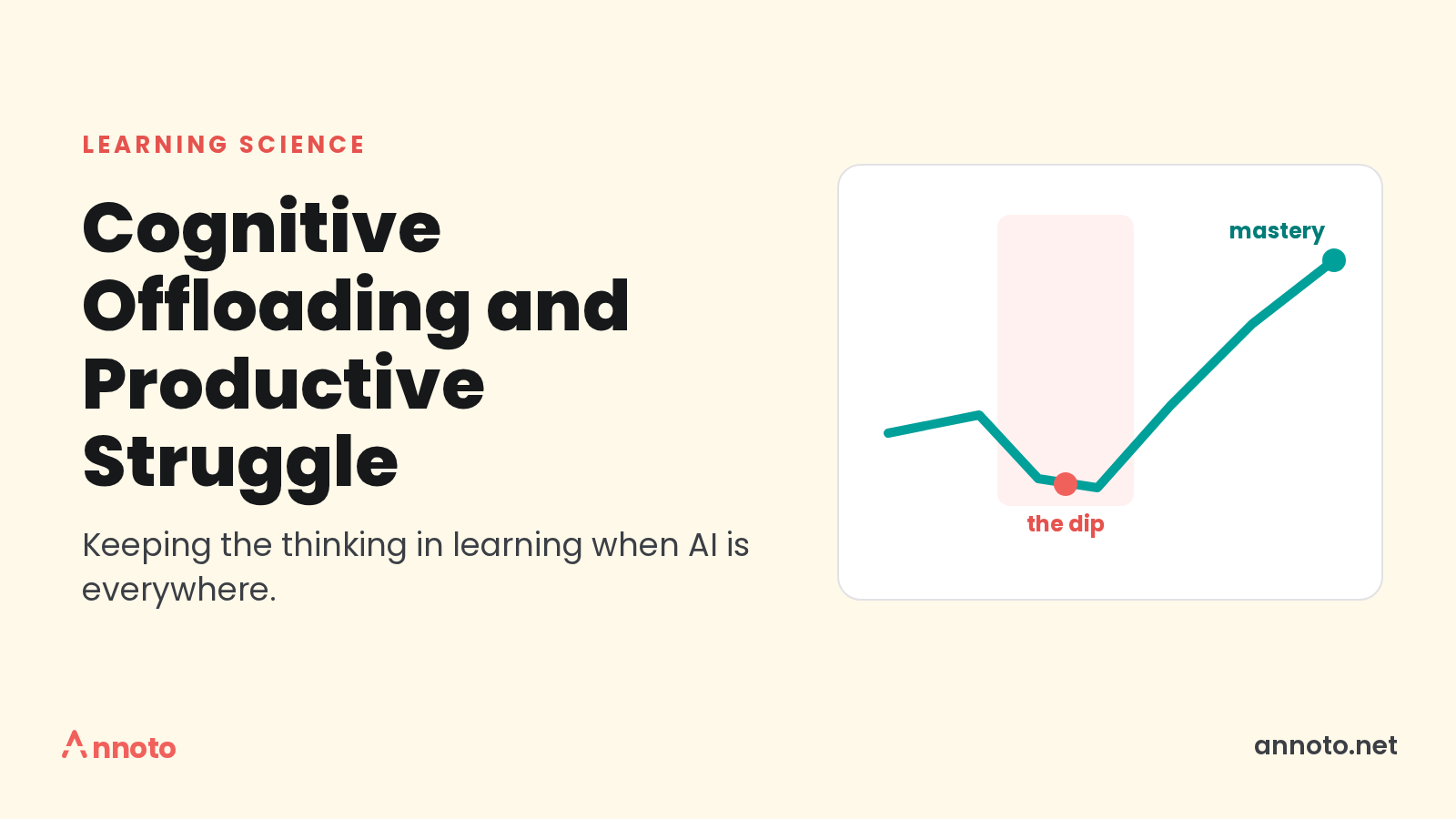
Do not read this research as a case for banning AI; both the Berkeley authors and AERO point the same direction, toward tools and designs that keep the learner thinking. Protect the first attempt structurally, with retrieval built into the material itself. Reward visible process, not just polished product. Choose AI that scaffolds instead of solves. And say the quiet part to students directly: the dip in the middle of learning is not a malfunction to be optimized away, it is the mechanism, and a course that removes it has removed the product it was selling.