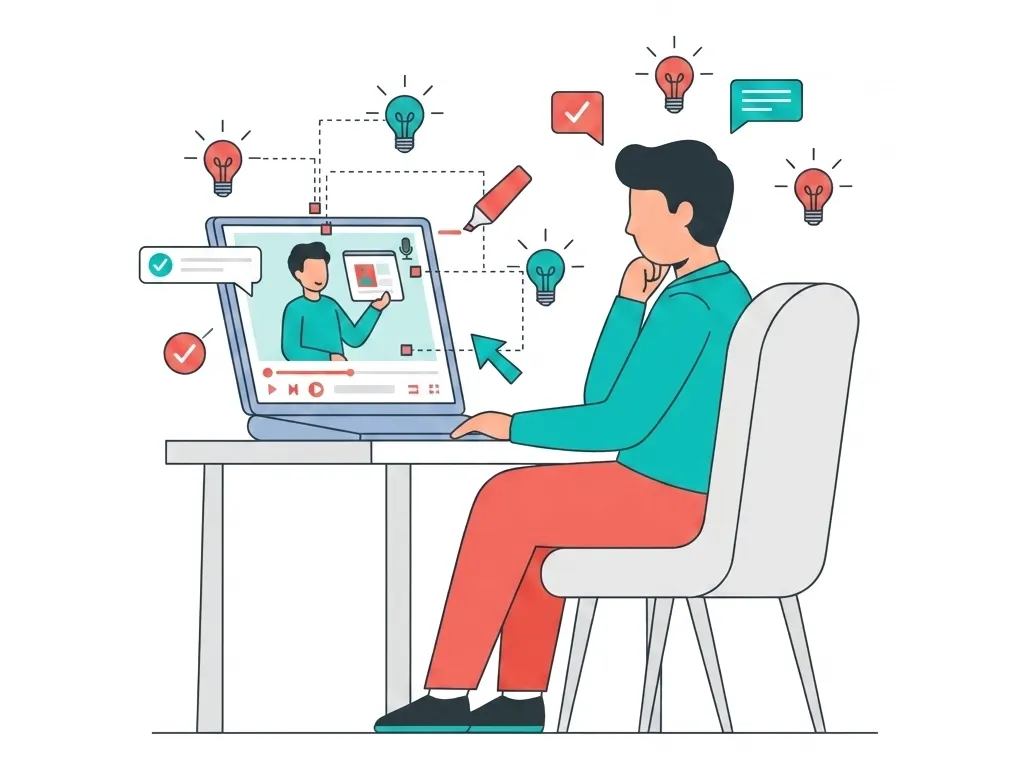
Why Passive Video Fails (and What Active Learning Fixes)

What does active learning really mean?
Active learning gets used so loosely that it has started to mean nothing. It is not group work for its own sake, it is not "no lecturing ever," and it is not a personality type that some students have and others lack. At its core, active learning is a simple claim backed by a long research record: students learn more when they generate, discuss, and apply ideas than when they only receive them. The activity that matters is cognitive, not physical. A student sitting quietly but working hard to answer a question is being active. A student loudly copying notes off a slide may not be.
A few tired myths are worth clearing out. Active learning does not mean abandoning content or coverage. It does not require flashy technology. And it is not opposed to lectures or video. It is opposed to passivity. You can deliver a brilliant explanation and still leave students passive if you never ask them to do anything with it. The question is never whether you used video. It is what the student did while it played.
The passive-video trap in online and flipped courses
Here is the irony. Many courses adopt video precisely to make room for active learning. The flipped model moves the lecture to video so class time can be spent on problems and discussion. Online courses lean on video to carry the content load. In both cases the intention is sound, and in both cases the video itself quietly reverts to lecture, the most passive format there is.
A student pressing play on a 30-minute recording is doing roughly what a student in the back row of a hall does: receiving, maybe half-attending, generating almost nothing. The medium changed but the cognitive demand did not. Worse, alone at a laptop the student loses even the ambient accountability of a room. This is the passive-video trap: the tool meant to free up time for active learning becomes the place where learning goes passive.
The engagement ladder: passive to active to constructive to interactive
The clearest way to think about the fix comes from the ICAP framework, which sorts learner behavior into four modes that climb in cognitive demand and, generally, in payoff.
- Passive. Receiving without overt action. Watching a video straight through.
- Active. Doing something physical with the material. Pausing, rewinding, re-watching a hard segment, taking notes.
- Constructive. Generating something new. Answering a question, writing an explanation, posing your own question.
- Interactive. Building on ideas in dialogue with others. Discussing, debating, responding to a peer.
The evidence for climbing this ladder is concrete. A study of biology undergraduates found that how students cognitively engage with instructional videos predicts how they learn from them, with active behaviors like deliberate rewinding predicting higher exam scores, and the authors conclude that passive watching is likely not enough to foster learning. Research on interactive video grounded in the ICAP framework points the same way: moving from one-way to two-way to multi-way interaction progressively improves motivation, reduces cognitive load, and enhances retention. Additional work confirms that interactive video enhances student engagement compared with passive playback.
Five ways to make any video active this term
You do not need a new platform philosophy to move up the ladder. You need to give students something to do at specific moments. Five practical moves, roughly in order of effort:
- Interpolate questions. Drop a short check into the video at the points that historically confuse people. Brame's synthesis notes that students who got questions interpolated into a video took more notes and found the session less mentally taxing. Use in-video checks to force retrieval, not to grade.
- Ask for a timestamped note. Have students record one question or one paraphrase at a moment that matters, turning receiving into generating.
- Open a discussion prompt. Anchor a genuine question to a debatable moment so students respond to the content and to each other.
- Assign a short application. Pair the video with a small task, one of Brame's core recommendations for embedding video in a context of active learning.
- Have students reply to a peer. The top of the ladder is interactive, and one required reply turns a set of monologues into a conversation.
Each of these can sit directly on the video timeline, so the action happens where the content is instead of in a separate tab the student never opens.
Discussion as active learning: turning comments into thinking
Discussion is the most underused active-learning move in video courses, partly because the standard tools make it awkward. A separate forum forces students to reconstruct the moment in prose and strips the conversation out of the content. In-video discussion puts the comment where it belongs, anchored to the exact second it refers to. That small change has outsized effects: questions get specific because the timestamp carries the context, answers become reusable for the next student who reaches the same point, and quieter students who would never speak in a hall will often type a question in place.
This is active learning in the strict ICAP sense. Writing a question is constructive. Answering a peer is interactive. Both happen against the exact content that prompted them, which is what keeps the thinking anchored to the material rather than drifting into vague generalities.
Measuring whether it worked
The reason context matters is that engagement is not automatic. Research on active learning with online video shows that the learning context shapes how engaged students actually are with the same footage. So you have to look. Watch two families of signal. Participation signals tell you whether students are doing the active work: how many answered the checks, how many posted or replied, where comments cluster. Comprehension signals tell you whether it helped: performance on the in-video questions, where attention drops off, and which segments generate the most confusion. Together they tell you far more than a view count, which only confirms a file was opened.
A one-week pilot plan for instructors
Active learning does not require rebuilding a course. Run a one-week test on a single video.
- Choose one video students already have to watch.
- Add two interpolated questions at the historically confusing moments.
- Post one anchored discussion prompt and require one peer reply.
- Ask each student to leave one timestamped note with a lingering question.
- At the end of the week, read the participation and comprehension signals and move your prompts to where the data says students actually struggle.
That is a single video and an afternoon of setup. It is also, for most courses, the cheapest high-leverage change available. Whether you teach online, flipped, or on campus in higher education, embedding response, reflection, and discussion into the timeline is how video stops being a place learning goes passive and becomes a place students actually do the work.
Keep reading
Related: Meet Lumo: AI That Turns Video Into a Conversation, Bentley University: Annoto Across Every Online Learning Use Case, and Peer Review, On The Timeline: Feedback Where It Happens.
Go further: Active Learning at Scale: Engaging Large Cohorts Without Burning Out Faculty shows how these techniques hold up in a 200-person course, and Lumo, Annoto's AI copilot, drafts the in-video questions and summaries they rely on.
New to Annoto? Start with What is Annoto?, or see it inside your LMS: Canvas, Moodle, Blackboard, and Brightspace.