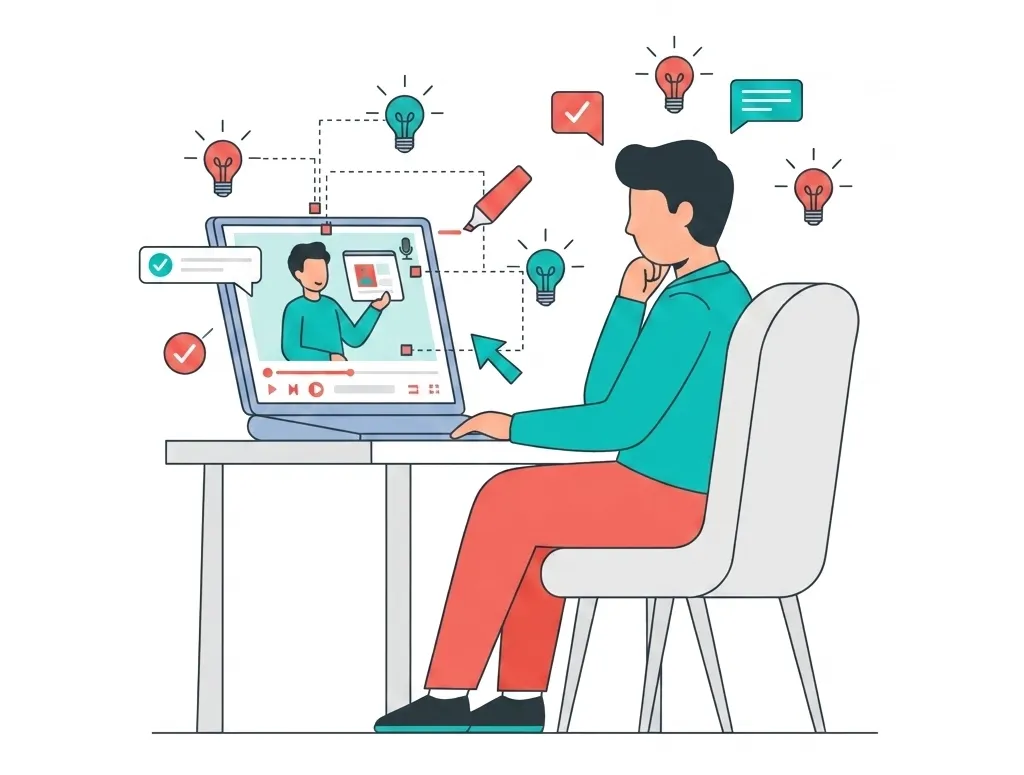
AI in Medical Education: Where Video, Simulation and Feedback Meet
Medical education has quietly become the proving ground for AI in teaching. The searches tell the story: "AI in medical education" now ranks among the most queried AI-in-education topics, and the reason is structural. Medicine trains judgment under uncertainty, assesses skills rather than essays, runs on video from the simulation lab to the lecture hall, and cannot afford a graduate who only looks competent. Every hard question the rest of higher education is starting to ask, medical educators have been forced to answer first.
This article maps where AI genuinely helps in medical education, where it is dangerous, and what programs can implement this academic year, with a focus on the video workflows where most clinical teaching already lives.
Why medical education is different
Three features set med ed apart from the average AI-in-education conversation. First, the stakes are asymmetric: a hallucinated fact in a history essay costs a grade, a hallucinated contraindication costs a patient. Verification is not a nice-to-have competency, it is the core professional skill. Second, assessment is already performance based. OSCEs, simulation debriefs, bedside evaluations and oral exams measure what a student does, not what they can produce as text, which makes the field structurally resistant to the essay-outsourcing crisis and structurally dependent on observation at scale. Third, the curriculum is saturated with video: recorded lectures, procedure demonstrations, simulated patient encounters, students' own recorded practice. The question is never whether to use video, it is how to make hours of it teach.
Where AI helps today
Making lecture video answerable. Preclinical students watch enormous volumes of recorded content, and the failure mode is well documented: watching is not understanding. In-video comprehension checks placed at the moments that matter, the mechanism, the dosage logic, the diagnostic fork, convert passive review into retrieval practice. AI now removes the authoring bottleneck: it can draft timestamped questions from the lecture itself, with faculty approving and refining rather than writing from scratch. Our piece on video comprehension checks covers placement principles that transfer directly to basic science teaching.
Answering inside the video, from the course. A student stuck at minute 32 of a cardiology lecture at midnight has three options: scrub back through the hour, post in a forum and wait, or ask a general chatbot that has never seen the course and may confidently improvise. An in-video assistant grounded in the actual course material changes the calculus, the answer comes from what the professor taught, anchored to the moment of confusion, and the program gets a live map of what the cohort finds difficult. For faculty, that confusion map is itself a teaching instrument: it shows exactly which segment needs a better explanation next year.
Timestamped feedback on clinical skills video. The highest-value use of video in med ed is watching learners perform: patient interviews, suturing technique, case presentations. The traditional bottleneck is feedback, a faculty member writing "communication needs work" at the end of a ten-minute encounter helps far less than a comment pinned to the exact seconds where the student interrupted the patient. Timestamped annotation turns one recording into a frame-by-frame coaching session, and peers can learn from each other's reviews. The same mechanics we describe for peer review on the timeline apply, with rubrics, to OSCE preparation and simulation debriefs.
Scaling oral assessment. As text-based assessment loses evidentiary value across higher education, medicine's old standby, the oral exam, is suddenly everyone's model. Video makes it scale: structured recorded vivas, asynchronous faculty review, timestamped scoring against a rubric. We laid out the full workflow in scaling oral exams with video; medical programs are its most natural adopters because the format is already native to the field.
Where the risks concentrate
Two risks deserve naming. Hallucination is the obvious one: a general-purpose model asked a clinical question produces fluent, plausible, occasionally wrong answers, and fluency is precisely what makes the errors dangerous for a novice who lacks the pattern library to catch them. The design answer is grounding, assistants constrained to course material, with sources visible, and a curriculum that treats verification as an assessed skill rather than an honor-system hope.
The second risk is the atrophy problem. Diagnostic reasoning is built through productive struggle: forming a differential, being wrong, revising. An AI that hands over the differential removes the struggle and with it the learning, the same cognitive offloading effect now documented across disciplines. The protection is structural, not rhetorical: first attempts happen in observable settings, in simulation, in video checks, in oral formats, where the thinking is visibly the student's own.
Practical takeaways for program directors
Start where the video already is: add AI-drafted, faculty-approved comprehension checks to the ten most-watched preclinical lectures and measure the difference in exam performance. Ground any student-facing assistant in your own curriculum and require it to show sources. Move one written assessment per term to a recorded oral or skills format with timestamped rubric feedback. Use cohort-level confusion data, where questions cluster on the timeline, to drive curriculum revision instead of end-of-term surveys. And write the AI policy as zones rather than bans, because your students are already using these tools in the wards and corridors, and pretending otherwise teaches only concealment.
Medical education's advantage is that its traditions, observation, oral defense, supervised practice, are exactly the assessment forms the AI era rewards. The programs that pair those traditions with well-grounded AI will set the standard the rest of higher education follows.