Oral Exams Are Back: How to Scale Oral Assessment With Video
Oral exams are back because AI makes polished written work a weaker signal of understanding. Universities including Cornell, Penn, NYU, and UC San Diego are adding short oral defenses and conversations to their courses. The challenge is scale. Video helps by letting students record structured responses, letting markers review and moderate asynchronously, and keeping live time for short follow up conversations.
Why are oral exams coming back in the age of AI?
Oral exams are returning because instructors are seeing polished written work from students who cannot explain it. A conversation quickly shows whether understanding is there.
An Associated Press report published by Fortune in March 2026 described the trend across several campuses. At Cornell, a biomedical engineering course with 70 students pairs written problem sets with 20 minute oral defense sessions, split between the professor and teaching assistants. The same report describes 30 minute final conversations in a religious studies course, four minute mock interviews in a 180 student engineering class, and faculty workshops on oral exams at Penn.
The shift fits a wider pattern. The 2026 EDUCAUSE Horizon Report: Teaching and Learning Edition describes institutions moving toward authentic, process based demonstrations of learning as AI complicates traditional assessment. If you are weighing detection tools instead, our post asking do AI detectors work reviews the evidence.
Do oral exams actually improve learning?
Early evidence suggests they can, beyond simply deterring AI misuse. Students prepare differently when they know they will have to explain their work out loud.
At UC San Diego, engineering professor Huihui Qi led an NSF funded project on oral exams in large engineering courses. In a comparison trial reported in 2023, students randomly assigned to a roughly 15 minute oral exam with the instructor saw second midterm scores rise 14%, versus 3% with a TA and negligible change with no oral exam. Across 560 students surveyed, 70% agreed that oral exams increased their motivation to learn, with first generation students agreeing at a higher rate. The researchers described these results as preliminary.
The same coverage notes the cost: oral exams are labor intensive. That is the problem a good scaling plan has to solve.
How do you scale oral assessment for large classes?
You scale oral assessment by keeping each conversation short, sharing marking across a team with one rubric, and moving the parts that do not need to be live into recorded video.
The University of Sydney's guidance on interactive orals argues they can work for large cohorts when tutors share the marking. It estimates that a 10 to 15 minute conversation can assess the equivalent of a 3,000 word written submission, and suggests planning 20 minutes per student at first, then 15 once markers are comfortable.
Dublin City University's February 2026 implementation guide recommends about 10 minutes of conversation plus 5 for marking, and no more than about 20 sessions per marker per day. It also suggests pair or group formats for large cohorts and recording sessions for quality assurance and moderation.
Video adds a third lever. A recorded component lets every student answer a common prompt on their own schedule, while live time goes to the follow up questions that really test understanding.
What is a video oral exam?
A video oral exam is an oral assessment where some or all of the student's spoken answers are recorded, then reviewed and graded against a rubric. It can be fully asynchronous, or a hybrid of recorded and live parts.
There are three common formats:
- Asynchronous recorded response. Students record a short explanation of their work in response to a prompt. Best for checking that every student can walk through their reasoning.
- Live session, recorded. A live viva voce assessment over video conference, recorded so a second marker can moderate. Best for high stakes finals.
- Hybrid. A recorded walkthrough first, then a short live conversation that probes what the recording revealed. Best balance of reach and depth for most courses.
One caution: Sydney's guidance warns that online oral assessments are not fully secure, in part because of deepfake video. Build identity checks into your process, and keep at least one live or in person moment for high stakes decisions.
A step by step playbook for scalable oral assessment
This playbook assumes a hybrid design: a recorded video component plus a short live follow up. Adjust the timing to your cohort.
- Start from learning outcomes. Pick two to four outcomes the oral component will assess. The rubric and every prompt should map back to them.
- Write a scenario, not a quiz. Frame the task as a realistic situation: briefing a client, defending a design choice, explaining a result to a colleague. Scenario prompts invite reasoning rather than recall.
- Build the rubric and a mock example. Record a short sample response and have students mark it against the draft rubric in class. DCU's guide recommends this step, and it doubles as preparation that reduces anxiety.
- Set the recorded component. Ask each student for a three to five minute video walking through their submitted work. Give the prompt in advance so preparation, not improvisation, is what you are measuring.
- Review with time coded feedback. Markers watch the recordings and leave comments at specific moments, tied to rubric criteria. Each comment becomes a natural question for the live follow up.
- Run short live follow ups. Schedule 8 to 10 minute conversations. Start with an easy opening question, then probe one or two points flagged in the recording.
- Moderate across markers. Have markers double score a small sample of recordings and compare. Agree on what each rubric level sounds like before grading the full set.
- Return feedback and debrief. Share individual rubric results and a short class debrief on common strengths and gaps.
Some teams run steps four and five in an interactive video tool. With Annoto, for example, students submit video assignments and markers leave time coded feedback against a rubric; scores can sync to the LMS gradebook through LTI integrations. Recording inside your LMS or a video conference tool also works; the playbook matters more than the platform.
A simple rubric for oral exams
A short rubric with four or five criteria keeps marking fast and consistent across a team. Score each on a three or four level scale.
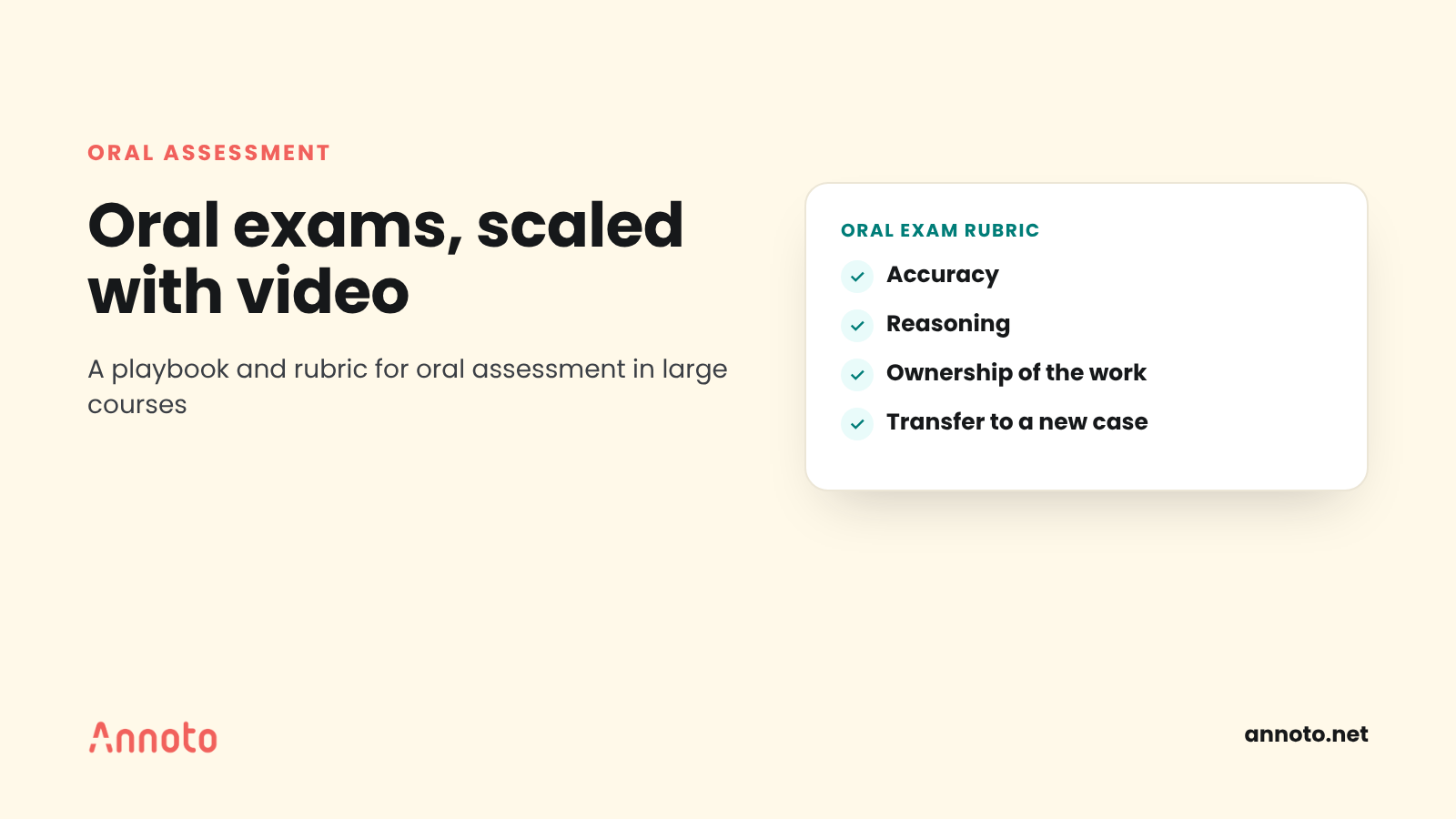
- Accuracy. Explains core concepts correctly and uses terms precisely.
- Reasoning. Justifies choices and connects evidence to conclusions.
- Ownership of the work. Can explain specific decisions in their own submission, including what they would change.
- Transfer. Applies the idea to a new case or a "what if" question.
- Response to probing. Handles a follow up question by reasoning through it, even when unsure.
Note what is missing: polish and fluency. Sydney's guidance recommends not grading communication quality unless it is a stated learning outcome, which keeps the rubric fair to anxious students and non native speakers.
How do you keep oral exams fair for anxious students?
Make the format predictable. Explain it clearly, share the rubric and a sample, and open with an easy question. The AP report notes that advocates recommend these steps, and that some students who were nervous at first came to prefer the format.
A recorded first round helps too. Students can retake a video before submitting, which lowers pressure while still capturing their own voice. Keep standard accessibility adjustments available, and confirm your recording and retention practices against institutional privacy policy.
Key takeaways
- Oral exams are spreading across universities as a response to polished work students cannot explain.
- Early UC San Diego results link oral exams with higher scores and motivation, though they are labor intensive.
- Short conversations, shared marking, and one rubric make oral assessment workable for large cohorts.
- A hybrid of recorded video plus brief live follow ups balances reach and depth.
- Grade reasoning and ownership, not fluency, and moderate across markers.
Frequently asked questions
How long should an oral exam be?
Guidance from the University of Sydney and Dublin City University points to about 10 to 15 minutes of conversation. Cornell examples in the AP report range from four minute mock interviews to 30 minute final conversations.
Can oral exams work in a class of 200 or more?
Yes, with shared marking and a common rubric. A recorded video component reduces live time, and pair or group formats are another option for very large cohorts.
Is a recorded video response secure enough for a final exam?
On its own, it may not be. Pair recorded work with identity checks and at least one live or in person follow up for high stakes decisions.
What is the difference between a viva voce and an interactive oral?
A viva voce is a traditional oral examination, often a structured defense of written work. An interactive oral, as Sydney describes it, is a scenario based conversation that unfolds differently for each student.
To see how video assignments and time coded rubric feedback support oral assessment in practice, visit Annoto for higher education.