Do AI Detectors Work? A Better Way to Assess Student Learning in 2026
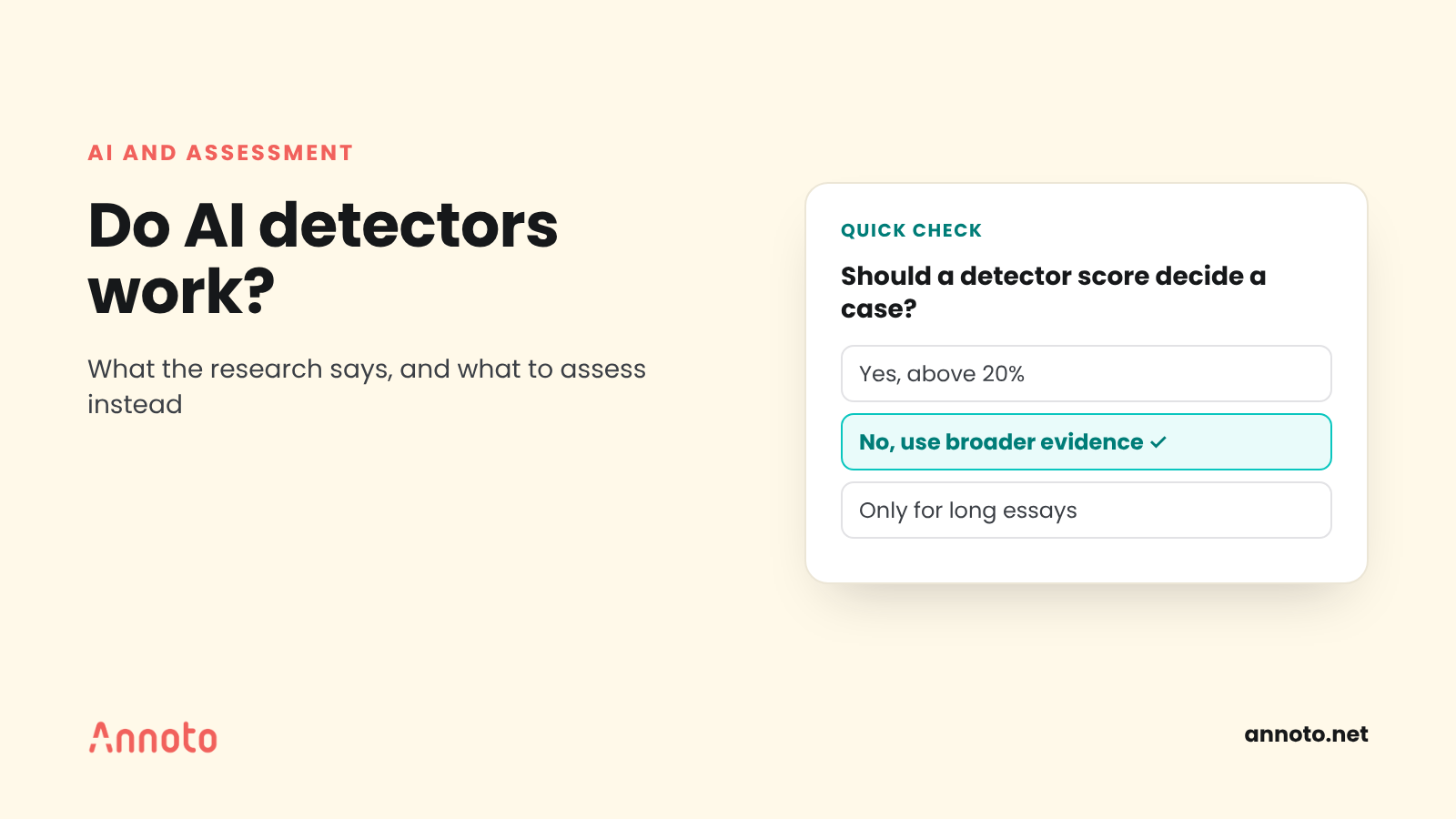
Do AI detectors work? Not well enough to decide a student's grade or integrity case on their own. Peer reviewed testing has found popular detectors neither accurate nor reliable, they can be fooled by light paraphrasing, and they misflag some honest writers. A stronger approach is to assess the learning process itself: drafts, time stamped work, short oral check ins, and video reflections.
Do AI detectors work in 2026?
AI detectors can sometimes spot unedited machine text, but the research does not support using them as proof. That gap matters, because an integrity decision needs evidence that holds up when a student challenges it.
Interest in the tools is high. Faculty want a quick answer to a hard question, and a percentage score looks like one. The trouble is what sits behind the score: a statistical guess about writing patterns, not a record of who did the work or how.
Even the builders of these tools have been cautious. OpenAI withdrew its own AI text classifier in 2023, citing its low rate of accuracy. At launch, the company had reported that the classifier caught 26% of AI written text in a challenge set and wrongly labeled 9% of human text as AI.
What does the research say about AI detection accuracy?
Independent testing has found detection accuracy too low and too easy to defeat for high stakes use. Three findings stand out.
- Accuracy is weak overall. An eight author team tested 14 tools, including Turnitin and PlagiarismCheck, and concluded in the International Journal for Educational Integrity (2023) that the tools are neither accurate nor reliable. They tended to label AI output as human, and obfuscation such as paraphrasing cut performance further.
- Some writers are flagged more often. Liang and colleagues found that several widely used GPT detectors repeatedly misclassified writing by non native English speakers as machine generated, while correctly identifying samples from native writers.
- Real classrooms differ from the lab. Turnitin itself acknowledged that real world use produced different results from its lab testing and that false positives were more common when less than 20% of a document was flagged.
Humans are not a reliable backstop either. Brandeis University's AI task force summarizes a study in which faculty and students identified AI generated text correctly only about a quarter of the time.
What do vendors and universities say about false positives?
Vendors report low false positive rates, but even a small rate becomes a real number of students at scale. That is the core reason several institutions have stepped back.
In a May 2023 update, Turnitin's chief product officer said its document level false positive rate was under 1% for documents with over 20% AI writing, with a sentence level rate around 4%. The company added an asterisk to scores under 20% to signal lower reliability, and stated that false positives cannot be fully eliminated. It framed the score as a way to start a conversation with a student.
Vanderbilt University did the arithmetic. It submitted about 75,000 papers to Turnitin in 2022, so a 1% false positive rate could have meant roughly 750 student papers wrongly flagged. Citing that risk, limited transparency, and bias concerns, Vanderbilt disabled the detector in August 2023.
The fair reading is this: a detector score can prompt a question, but it should never be the only evidence in an integrity case. Check your institution's academic integrity policy for how it treats detector output.
What is AI resistant assessment?
AI resistant assessment is design that makes the student's own thinking visible, so you do not have to guess who wrote the final product. No task is AI proof, but some tasks reward understanding that a chatbot cannot supply on a student's behalf.
This is where the sector is heading. The 2026 EDUCAUSE Horizon Report: Teaching and Learning Edition notes that AI increasingly complicates traditional assessments and describes institutions shifting toward authentic, process based demonstrations of learning. We covered the broader design principles in our post on authentic assessment in the AI era.
AI resistant tasks usually share a few traits:
- They tie to something specific: a lab the class ran, a local dataset, a discussion from week four.
- They ask students to explain choices, not just present results.
- They collect evidence over time rather than at a single deadline.
- They include a moment where the student has to respond live or in their own voice.
How does process based assessment work in practice?
Process based assessment grades how a student got to the answer, not only the answer. You collect small, time stamped artifacts along the way and look for a coherent story of thinking.
Here are four practical alternatives to detector scores, from lightest to heaviest lift.
- Collect process evidence. Ask for an outline, a messy first draft, and a short revision memo explaining what changed and why. Version history in a shared document is useful context, though it is not proof on its own.
- Add oral check ins. A five minute conversation about a submitted paper reveals quickly whether a student can explain their argument. Universities are reviving this practice at scale, which we explore in our post on scaling oral exams with video.
- Use video reflections. Have students record a two to three minute walkthrough of their reasoning: why they chose a source, where they got stuck, what they would do differently. A short recording in the student's own voice is much harder to outsource than a polished essay.
- Anchor work to time stamped moments. Ask students to respond to specific points in a lecture or case video, for example by commenting at the moment a concept is introduced. The responses are tied to content only your course contains, and they build up across the term.
A concrete example: in a policy course, replace a single 2,500 word paper with three checkpoints. Week three is an annotated source list. Week six is a draft with a 150 word revision memo. Week nine is a three minute video defending the main recommendation, with peers leaving time coded questions. Each checkpoint is small, and together they show how the student's thinking developed.
Where does video fit into AI resistant assessment?
Video gives you a scalable way to capture the student's voice and reasoning without scheduling dozens of live meetings. It also creates a record you can revisit when grading or moderating.
Platforms built for this vary. Some instructors use the recording tools inside their LMS; others use a dedicated interactive video layer. In Annoto, for instance, students can record or upload video assignments, and instructors and peers leave time coded feedback against a rubric. The same layer supports time stamped comments and discussion on course videos, which turns viewing into visible, dated participation.
Whatever tool you choose, keep the design principle in front: you are collecting evidence of thinking, not policing text. That also protects students from the reasoning shortcuts we described in our post on cognitive offloading and productive struggle.
Key takeaways
- Peer reviewed testing has found AI detectors neither accurate nor reliable, and easy to defeat with paraphrasing.
- Detectors can misflag honest writers, including non native English speakers, so a score should never be the sole evidence.
- Small false positive rates still add up to many students at institutional scale.
- Process based assessment, oral check ins, and video reflections show student thinking directly.
- Design tasks around course specific content and collect evidence across the term.
Frequently asked questions
Can AI detectors prove a student cheated?
No. Research and vendor statements both point to false positives and missed detections, so a score is at best a reason to ask questions. Integrity decisions should rest on broader evidence, such as drafts and a conversation with the student.
Are AI detectors biased against some students?
Research suggests they can be. Liang and colleagues found detectors misclassified writing by non native English speakers as AI generated more often than writing by native speakers.
What is the simplest alternative to AI detection?
Add a short oral or video check in to an existing assignment. Asking a student to explain two or three of their choices in their own voice quickly shows whether they understand the work.
Does process based assessment take more grading time?
It shifts time rather than simply adding it. Small checkpoints are quick to review, and a clear rubric keeps feedback focused, which can reduce time spent investigating suspected misconduct later.
If your institution is rethinking assessment for the AI era, see how interactive video supports process evidence and video reflections in Annoto for higher education.