Social Annotation for Video: What Perusall Does for Readings, Done for Lectures

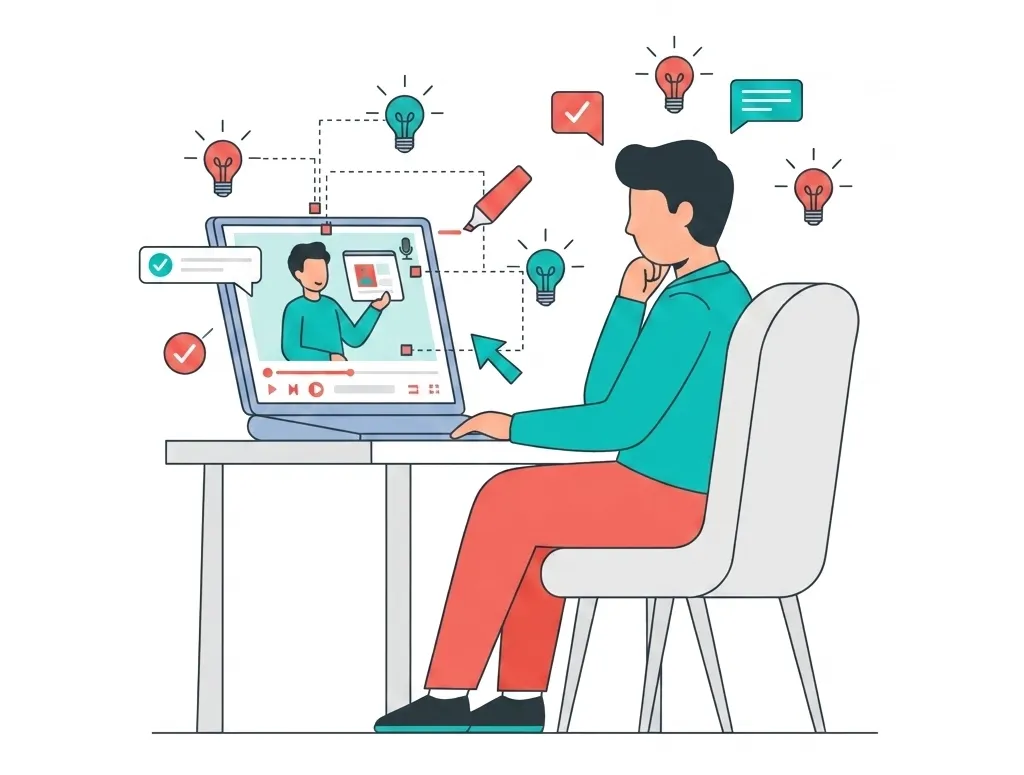
Social annotation for video means students comment on specific moments of a lecture recording, reply to each other in threads anchored to the timeline, and the instructor can see, grade and learn from the result. Perusall does this for readings; a video engagement layer such as Annoto does it for the lecture videos your institution already hosts, inside the LMS. The two are not rivals so much as neighbors, and many campuses run both.
Students who annotate a chapter together arrive in class having argued with the text and with each other. Students assigned a 48 minute recording often arrive having watched the first eleven minutes at double speed. This post is about closing that gap.
What Perusall does well, and where its design center sits
Credit first. Perusall built its reputation on margin threads: a student highlights a passage in a PDF or catalog textbook, writes a comment, and classmates reply, upvote and ask questions. Three things make it more than a discussion board.
Engagement scoring. Perusall grades annotation automatically by default. As Boston College's guide to grading in Perusall explains, the platform "enables automatic grading based on an algorithm which measures the quality of student responses," with scoring templates and instructor override. The same guide warns that some advanced criteria "may inadvertently penalize students for positive behaviors."
The confusion report. For each assignment, Perusall surfaces "the top 3 or 4 topics of confusion or engagement" with the related passages, according to Teachers College's walkthrough. It is a useful pre class briefing, though VU Amsterdam's comparison with FeedbackFruits notes its accuracy is limited.
The catalog. Perusall can act as the bookstore. Under its Course Choice Model, for courses created from July 2026 without an institutional license, students either buy an adopted e book at the publisher's list price or pay a platform access fee, unless the department covers it as a lump sum.
Video exists in Perusall, but it is a guest in a house built for documents. The Perusall video article explains that you add a video by pasting a public YouTube or Vimeo URL, a cloud share link (small files only, because of bandwidth limits), or a direct MP4 link. Private videos cannot be imported, and automatically generated YouTube captions do not appear. Students can drop a comment dot on the timeline, which is the right basic gesture, but the videos live in Perusall's library rather than on your lecture capture platform.

What social annotation of a lecture video actually needs
A video is not a long PDF that happens to move. Five requirements separate a tool that supports social video learning from one that merely allows comments.
Timestamp anchoring. A comment must be bound to a second, not a page. When a student writes "I lost the derivation here" the instructor needs to land at 23:14, not scroll a list. Anchoring also reveals clusters: nine questions in a ninety second window is a signal no discussion board would show.
Threads with notifications. Replies, mentions and upvotes keep a conversation alive between viewing sessions. Without notifications, a question asked on Tuesday waits until the instructor opens the recording on Friday.
Instructor visibility and moderation. The instructor should see every thread across the course from one place, answer in context, pin a correction, and remove what should not be there.
Grading that fits video behavior. Participation credit should count comments, replies and quiz answers, and pass to the LMS gradebook without a spreadsheet. Scoring designed around reading time is a poor fit for a lecture students rewatch in pieces.
Analytics on watching, not just writing. Readings have no drop off curve. Video does. Knowing that attention fell away at minute 31, and that the students who stayed are the ones who commented, is information a document tool cannot produce. The video annotation glossary entry covers these distinctions.
Why the research applies to video as much as to text
The case for social annotation rests on two bodies of work, and neither is specific to reading. The ICAP framework (Chi and Wylie, 2014) ranks learning activities as passive, active, constructive or interactive, and predicts that interactive engagement, where learners build on each other's contributions, produces the deepest learning. Watching a recording is passive. Commenting at a timestamp is constructive. Replying to a classmate is interactive.
Social learning theory adds the second half: students model behavior on peers they can observe. In a reading tool they observe highlights. On video they observe where classmates paused, what they asked, and which explanation convinced the thread. Our overview of social learning on video platforms walks through the evidence, and the social video learning glossary defines the terms.

Where Annoto fits
Annoto is an engagement layer rather than a content library. It sits on top of the video platform your institution already uses, including Kaltura, Panopto, YuJa, YouTube, Vimeo and plain HTML5, and runs inside Canvas, Moodle, Blackboard, Brightspace and any other LTI 1.1 or 1.3 platform. Nothing is re uploaded and nothing leaves your video host.
On that video, students get timestamped threaded discussion with replies, mentions, reactions and notifications, plus private notes. Instructors get moderation, guided notes, polls, reflection prompts and graded in video quizzes on the same timeline. Participation and quiz results pass to the LMS gradebook through LTI, and the analytics report attention and comprehension per learner and per moment, so the confusion report for a lecture is the drop off curve and the comment clusters read together. Annoto is licensed to the institution, so students never see a payment prompt.
Be honest about the boundary. If your course is built on textbook chapters and journal articles, Perusall remains the better instrument, and its catalog integration has no equivalent in Annoto. The sensible configuration for many departments is Perusall for readings and Annoto for lectures, both reporting into the same gradebook. The full side by side is on the Annoto vs Perusall comparison page.
Frequently asked questions
Can Perusall annotate video?
Yes, with conditions. According to Perusall's support documentation, you add video by public URL from YouTube, Vimeo, a cloud share link or a direct file link, and automatically generated YouTube captions are not shown. Comments attach to the timeline. Lecture recordings behind a login on Kaltura, Panopto or similar are harder to bring in.
What is the difference between social annotation and video annotation?
Social annotation is the pedagogy: learners comment on shared material and respond to each other. Video annotation is the mechanism applied to a timeline instead of a page. They overlap when video annotation is threaded, visible to peers and anchored to timestamps, which is what social video learning describes.
Does Annoto replace Perusall?
Not for readings. Annoto works only on video and audio. Institutions that use both keep Perusall for documents and Annoto for lecture capture and course video, with grades from each flowing into the LMS.
Can I grade video annotations in the LMS gradebook?
With Annoto, yes. Comment participation, quiz scores and completion pass back through LTI to Canvas, Moodle, Blackboard or Brightspace, and the raw data can be exported as CSV or through the API.
How does Perusall grading work?
Perusall's engagement algorithm scores annotations on quantity, quality, timing and distribution across the reading, with criteria the instructor can configure and override. Video participation in Annoto is graded on quizzes, completion and discussion, with the result passed to the LMS gradebook over LTI.
Takeaways
Perusall proved that annotation becomes learning when it is social, scored and visible to the instructor. Video needs the same three properties plus one more: it must be anchored to time and measured by watching, not just by writing. A video engagement layer gives lecture recordings that treatment on the platform you already pay for, and coexists with a reading tool. To see timestamped discussion on one of your own course videos, book a short demo.