Compliance Training Completion Is Not Proof of Understanding: How to Show Both
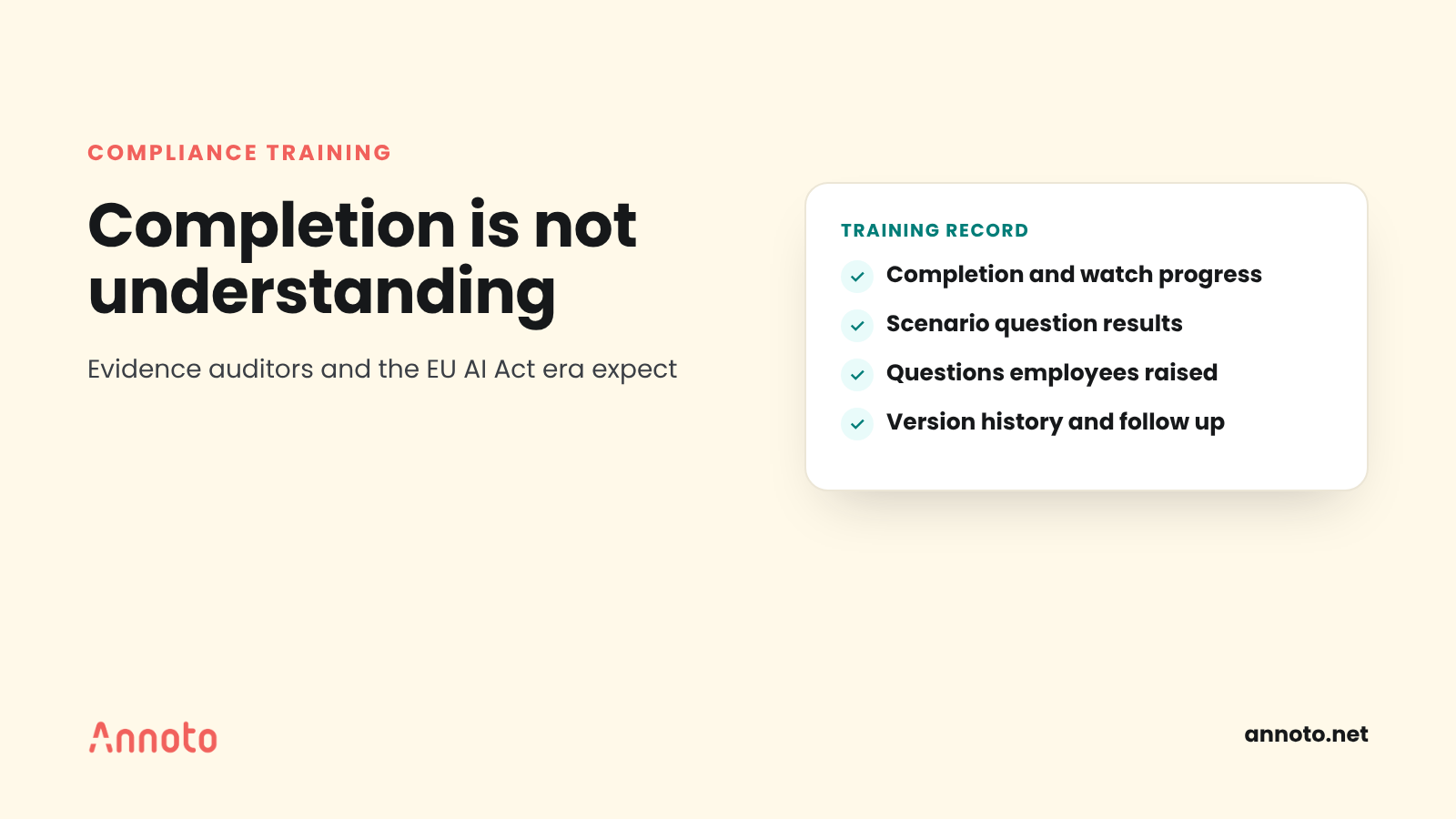
Compliance training completion shows that an employee opened and finished a module. It does not show they understood the policy or can apply it. To show both, keep the completion record and add evidence of understanding: questions answered at key moments, scenario responses, where people struggled, and what changed afterward. Regulators and auditors increasingly ask about effectiveness, not just attendance.
Why is compliance training completion not proof of understanding?
Compliance training completion proves exposure, not comprehension. A completion flag says the last screen was reached or the video played to the end. It says nothing about whether the employee could spot a conflict of interest, handle a data request correctly, or know when to escalate.
Learning research explains why the gap is wider than it looks. In a well known experiment, Roediger and Karpicke (2006) found that students who simply restudied material felt more confident they would remember it, yet recalled less a week later than students who were tested on it. Passive review creates a feeling of knowing. An annual module that people click through is a passive review.
That matters in three practical ways:
- Risk. The behaviors the training is meant to prevent still happen, because people did not retain the rule or how it applies to their job.
- Investigations. When something goes wrong, a record that says "completed" is weak evidence that the organization actually trained the person.
- Spend. Hours of seat time with no evidence of learning are hard to defend in a budget review.
What do regulators ask about compliance training effectiveness?
Regulators increasingly ask whether training works, not only whether it was delivered. In the United States, the Department of Justice guidance on evaluating corporate compliance programs has asked prosecutors to consider how a company measured the effectiveness of its training and whether employees were tested on what they learned. A 2020 revision added a question about whether the company evaluates the impact of training on employee behavior or operations, and about whether employees can ask questions arising from training.
Those questions describe a higher bar than a completion report. A program that can only show who finished a module will struggle to answer "how do you know it worked?" Guidance changes over time, so check the current version with your legal and compliance teams.
What does the EU AI Act require for AI literacy training?
Article 4 of the EU AI Act requires providers and deployers of AI systems to take measures supporting AI literacy among staff and others who use AI systems on their behalf. This section summarizes public sources and is not legal advice; confirm how it applies to your organization with counsel.
Key dates
The AI literacy obligation has applied since 2 February 2025. According to DLA Piper's summary of the European Commission's AI literacy Q&A, national market surveillance authorities are expected to supervise and enforce it from 2 August 2026, under national implementing laws.
The 2026 amendment
The wording changed in 2026. The Digital Omnibus on AI entered into force on 27 July 2026 and shifted Article 4 from ensuring a sufficient level of AI literacy to supporting it. The consolidated text on the Commission's AI Act Service Desk now says providers and deployers are not required to guarantee any specific level of AI literacy for an individual. Lewis Silkin notes that deployers of high risk systems still face more specific competence requirements under Article 26(2).
What documentation looks like
The Act sets no fixed training format and requires no certificate. Germany's market surveillance authority, the Bundesnetzagentur, says the Act does not explicitly require documentation but recommends keeping records of the measures taken, their content and duration, and who took part, along with regular evaluation and refresher training.
A practical AI literacy training record would capture:
- The AI systems or tools the training covered, tied to the roles that use them.
- The content and format of each measure, with the date and version.
- Who participated, and when.
- How understanding was checked, such as scenario questions on appropriate use, data handling and when to escalate.
- When the training will be reviewed as tools and uses change.
Even though the amended text no longer requires guaranteeing a level of literacy, item four is what lets you show the measures were meaningful. For a deeper look at the concepts, see AI literacy for students, which covers the same skills from an education angle.
How do you show both completion and understanding in a training records audit?
To pass a training records audit with more than attendance, pair each completion with evidence of what the learner demonstrated. The completion record answers "who was trained and when." The understanding record answers "what did they get right, and where did the program fall short."
A workable evidence set for each course includes:
- Completion and watch progress per learner, ideally down to which segments were watched rather than a single finished flag. See video completion tracking for what this can look like.
- Scenario question results placed at the moment each rule is explained, not only in a final test.
- Item level analysis showing which questions most people missed, and what you changed in response.
- Questions employees raised, with the answers given. This also responds to the regulator interest in whether employees can ask about training content.
- Version history, so you can show which content each person saw.
- A follow up signal, such as a short check months later or an operational measure like policy exceptions on that topic.
Keep these records exportable. Auditors and internal investigators usually want data in a format they can filter, not a dashboard screenshot.
How can you improve compliance training effectiveness without making it longer?
You improve compliance training effectiveness by replacing passive minutes with short moments of retrieval and judgment. Research on online lectures found that brief tests between segments reduced mind wandering and improved final test scores, without extending the lecture.
Practical changes that tend to help:
- Cut the module into segments, one rule or risk per segment.
- End each segment with a scenario. "A vendor offers you tickets to a final. What do you do?" tests judgment better than "What is the gift limit?"
- Explain wrong answers. Feedback turns a missed question into a teaching moment instead of a fail.
- Use real cases. Anonymized incidents from your own organization are more memorable than generic ones.
- Let people ask at the moment of confusion. A time stamped question on the exact policy point is easier to answer, and to log, than an email weeks later.
- Review the item data each cycle and fix the segments people consistently miss.
Interactive video layers are one way to do this on existing content. Annoto, for example, adds in video quizzes, time stamped discussion and per learner analytics to compliance videos, with results that can sync to the LMS and be exported, as described on its compliance page. For a related regulatory example, see how to prove regular and substantive interaction in video courses.
Key takeaways
- Completion shows exposure. Understanding needs separate evidence, such as scenario results and item analysis.
- US DOJ guidance asks how companies measure training effectiveness and whether employees are tested on what they learned.
- EU AI Act Article 4 has applied since 2 February 2025; national supervision is expected from 2 August 2026, and a July 2026 amendment shifted the duty to supporting AI literacy.
- No certificate is required for AI literacy, but authorities recommend records of content, duration and participants.
- Short segments with scenario questions improve effectiveness without adding seat time.
Frequently asked questions
Is compliance training completion enough for an audit?
It depends on the rule and the auditor, but completion alone answers only who was trained and when. Guidance such as the US DOJ evaluation questions also asks how effectiveness was measured and whether employees were tested. Pairing completion with question results and follow up data gives a stronger record.
Does the EU AI Act require AI literacy certificates?
No. Public guidance, including from Germany's Bundesnetzagentur, says no certificate or fixed format is required. Keeping records of the measures, content, duration and participants is recommended so you can show what you did if asked.
When is Article 4 of the EU AI Act enforced?
The AI literacy obligation has applied since 2 February 2025. National market surveillance authorities are expected to supervise and enforce it from 2 August 2026 under national laws. Confirm the position in your member state with counsel.
How do you measure compliance training effectiveness?
Track whether learners can apply each rule, using scenario questions placed where the rule is taught. Review which items people miss, revise those segments, and follow one behavior signal over time, such as policy exceptions or reported incidents on the topic.
For teams building compliance and AI literacy programs on video, the corporate learning overview describes how completion, questions and analytics can live in one record.