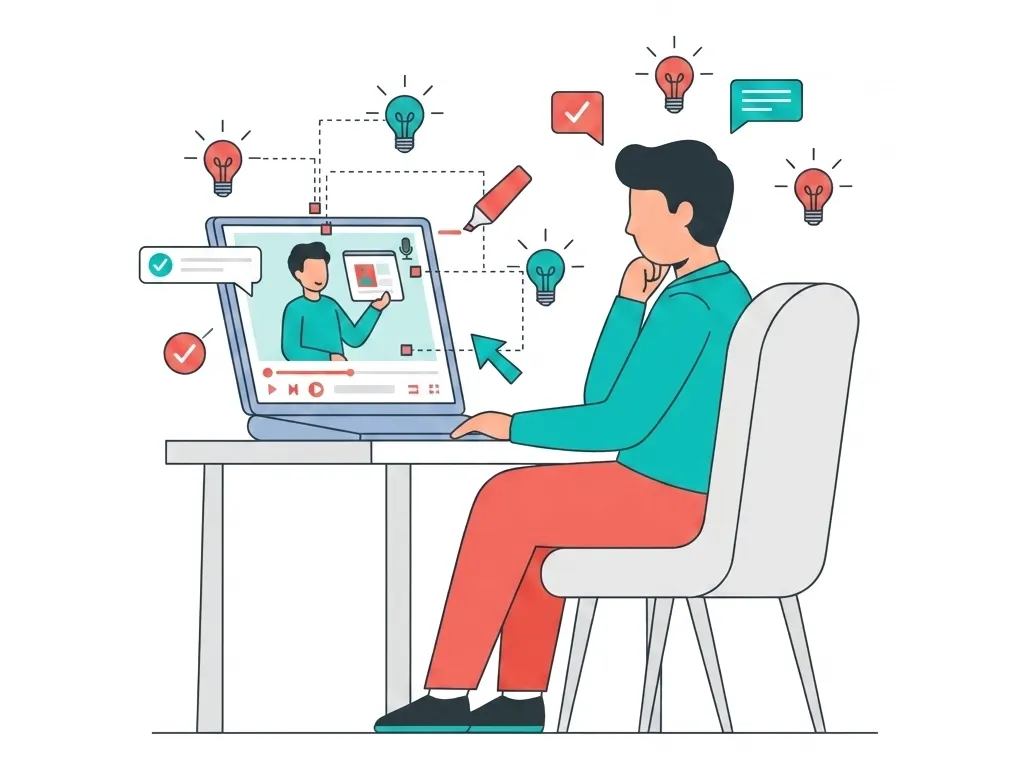
RSI Compliance: How to Prove Instructor Interaction in Video Courses
Online programs that touch federal financial aid live and die by a phrase most students never hear: regular and substantive interaction, or RSI. It is the legal line the U.S. Department of Education draws between a real distance education course and a correspondence course, and only one of those is eligible for Title IV funding. Post a semester of lecture videos with a discussion board bolted on the side, and you may believe you are teaching a distance course. An accreditor reviewing your Canvas shell in 2026 may see something closer to correspondence.
This article walks through what RSI actually requires, why passive lecture video on its own can fail the test, and how instructor-led interaction inside the video creates both the engagement regulators want and the paper trail they ask for.
What is RSI, and why does Title IV funding depend on it?
Federal regulation (34 CFR 600.2) separates distance education from correspondence education by the quality and cadence of interaction between students and their instructor. Distance education requires regular and substantive interaction initiated by the institution. Correspondence education does not, and correspondence programs face tight enrollment caps and, in most cases, lose eligibility for federal student aid.
The stakes are not abstract. If an institution labels a course as distance education, draws down Title IV aid for the students in it, and a review later concludes the course lacked RSI, the finding can put aid eligibility and the institution's standing with its accreditor at risk. That is why RSI has quietly become one of the most consequential compliance requirements in higher education, and why it belongs on the same shelf as your security and data-governance obligations rather than filed away as a pedagogy nicety.
"Regular" versus "substantive": the two tests a course must pass
RSI is not one requirement. It is two, and a course has to satisfy both.
Substantive interaction means engaging students in teaching, learning, and assessment directly tied to the course content. The federal definition requires that instructors do this through at least two of a defined set of activities: providing direct instruction, assessing or giving feedback on a student's work, answering questions about course content, facilitating discussion about the content, or other activities approved by the accrediting agency (WICHE Policy Tracker). The common thread is that the instructor is intellectually present and engaging with what students are actually doing.
Regular interaction means the opportunity for that substantive contact is predictable and scheduled, on a basis commensurate with the length and credit value of the course, and that the institution monitors students' academic engagement and reaches out proactively rather than waiting for them to surface. As the guidance from Ohio State's Office of Distance Education puts it, interaction should be scheduled, predictable, and initiated by the instructor, not left to whether a student happens to email (Ohio State ASC).
Read those two tests together and a pattern emerges. Availability is not interaction. A syllabus line that says "email me with questions" is reactive, not regular. And content that students merely receive, however excellent, is not substantive on its own.
Why uploaded lecture video, by itself, can look like correspondence
Here is the uncomfortable part for video-heavy courses. Pre-recorded lectures are a legitimate and valuable teaching tool, but the act of watching a video is a one-way transmission. The student receives; the instructor is not present, not responding, not assessing. On its own, a library of recorded lectures is exactly the kind of instructional material that has historically defined correspondence study.
Accreditor guidance is explicit that the instructor has to be the one initiating and sustaining interaction. SUNY's widely used RSI rubric within the OSCQR framework evaluates whether interaction is instructor-initiated, frequent, and academic in nature, not whether content was simply made available (SUNY OSCQR). A course can be rich with media and still come up short if the human loop, the instructor engaging with student thinking, is missing or invisible.
This is the trap. Teams invest heavily in production quality, assume that more and better video equals more teaching, and end up with a course that is beautiful, thorough, and structurally passive.
Interaction that counts: instructor-initiated, content-focused, scheduled
The fix is not to abandon video. It is to make the video a place where instructor and students actually interact, and to do it on a predictable cadence. Three properties turn watching into interaction that satisfies RSI:
- Instructor-initiated. The instructor plants prompts, questions, and checkpoints rather than waiting for students to ask.
- Content-focused. The exchange is about the concept on screen at that moment, not logistics or "great video, thanks."
- Scheduled and regular. These touchpoints recur throughout the term on a rhythm tied to the course length, not clustered around a single midterm.
An in-video discussion layer is built for exactly this. When students post questions and reflections anchored to a specific second of the lecture, and the instructor or a TA replies in that same context, you are running facilitated, content-related discussion, one of the substantive activities the regulation names. Annoto's in-video discussions and video assignments put that exchange on the timeline instead of on a separate, easily ignored forum.
Turning video into documented, auditable interaction
Satisfying RSI is half the job. Proving it is the other half, and it is where most programs struggle. When a reviewer opens a randomly selected course, they need to see evidence: who interacted, about what, and how often across the term.
This is the second reason in-video interaction beats a side discussion board. Every prompt, reply, and thread is timestamped and tied to the exact content it addresses. Instead of reconstructing a narrative after the fact, you can show a reviewer the actual record: instructor-initiated questions at week two, four, and seven; content-specific replies to student posts; participation that recurs on a schedule. Annoto's analytics turn that activity into a per-course, per-student view of engagement and interaction over time, which is precisely the artifact an RSI review is looking for.
Good documentation also protects instructors. When the evidence of regular, substantive interaction is generated automatically as a byproduct of teaching, faculty are not asked to keep a separate compliance log on top of everything else they do.
The 2026 enforcement picture
RSI stopped being theoretical. Accreditors are now reviewing individual courses for it. The Accrediting Commission for Community and Junior Colleges (ACCJC), for example, will begin looking at fully online courses using an RSI rubric in Spring 2026, with external reviewers accessing randomly selected courses directly in the LMS and faculty notified if their course is chosen (Cañada College). Random selection is the point: every fully online course has to be able to withstand the review, not just the flagship ones.
That changes the risk calculus. It is no longer enough for a program to have an RSI policy on paper. Each course has to embody it and be able to prove it on demand.
An RSI readiness checklist for online programs
- Confirm every distance course has at least two forms of substantive, instructor-initiated interaction, not just published content.
- Map interaction to a predictable schedule across the full term, sized to the course's length and credits.
- Move discussion into the video, where the exchange stays anchored to the content it concerns.
- Make sure a human, instructor or trained TA, is closing the loop on student questions and work.
- Capture timestamped evidence of who interacted, about what, and when, so a review is a matter of pulling a report rather than rebuilding a story.
- Monitor engagement proactively and reach out to quiet students, which is itself part of the "regular" test.
The programs that will sail through 2026 reviews are not the ones with the most polished lectures. They are the ones where the instructor is visibly, regularly, and substantively present inside the learning, and where the system quietly kept the receipts. Building that interaction into the video, rather than around it, is the most direct way to get both at once.
Keep reading
Related: One Engagement Layer, Any LMS and Any Video Host, Closing the Skills Gap: Video Training Corporate L&D Can Actually Meas, and NYU: Saving Time While Engaging Every Student In Active Learning.
New to Annoto? Start with What is Annoto?, or see it inside your LMS: Canvas, Moodle, Blackboard, and Brightspace.