The ICAP Framework: How to Turn Passive Video Into Active Learning
Every instructor who records lectures eventually asks the same question: my students are watching, so why are they not learning? The most useful answer research has produced in the last decade is the ICAP framework, developed by Michelene Chi and Ruth Wylie at Arizona State University. ICAP gives a name to something teachers sense intuitively, that not all engagement is equal, and it ranks four modes of engagement by how much learning each one produces. For anyone teaching with video, it doubles as a diagnosis and a roadmap.
What the ICAP framework says
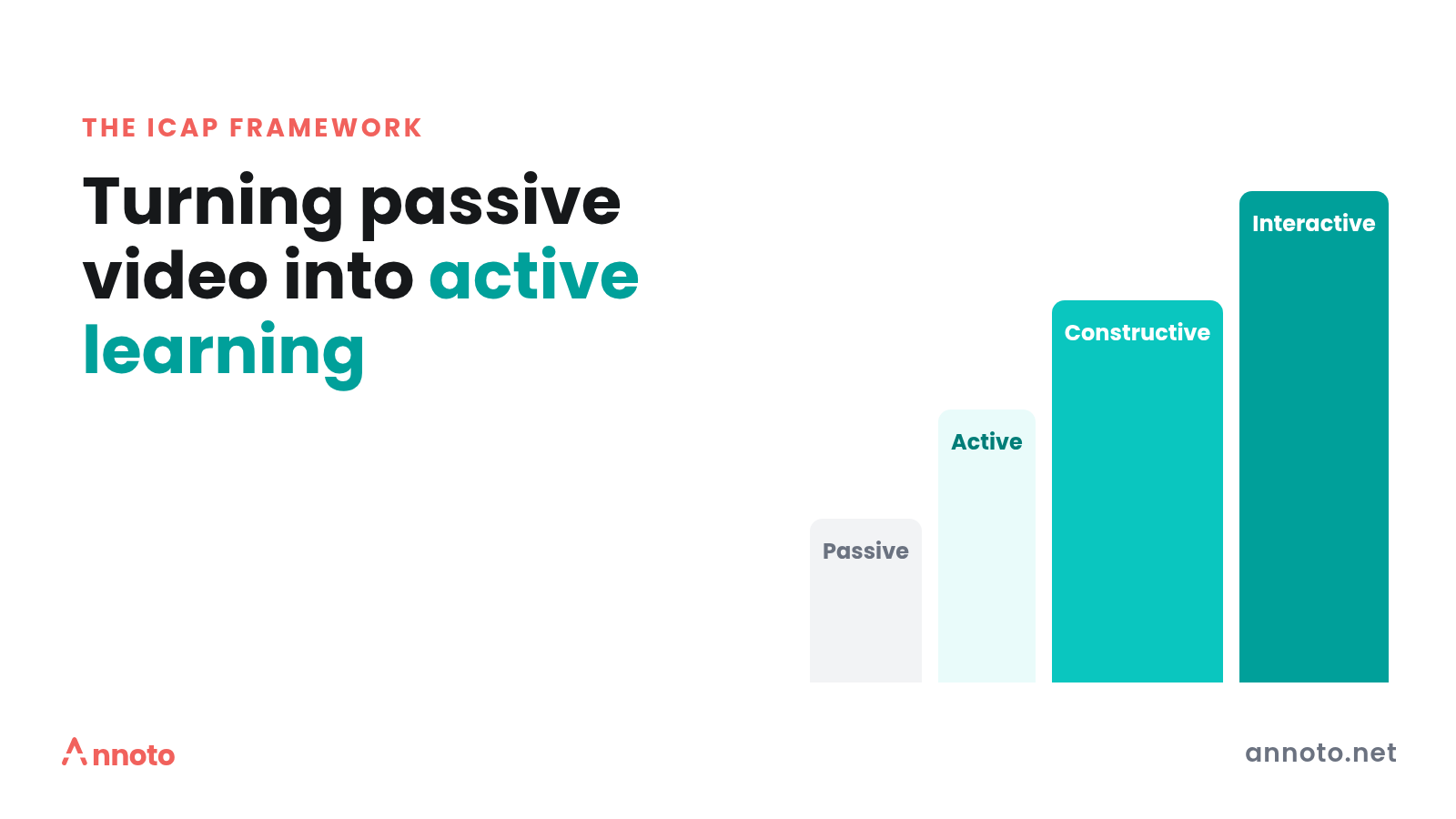
ICAP stands for Interactive, Constructive, Active and Passive, the four modes of cognitive engagement a learner can be in, ordered from most to least effective. The framework's central hypothesis, supported by dozens of classroom studies since the 2014 paper, is simple: as students move from passive to active to constructive to interactive, their learning increases.
Passive engagement means receiving information without doing anything with it. Watching a lecture video straight through, eyes on the screen, hands still. Active engagement means manipulating the material in some physical or attentional way: pausing, rewinding, taking verbatim notes, answering a recall question. Constructive engagement means generating something that goes beyond what was presented: writing a summary in your own words, drawing a concept map, posing a question the video never answered. Interactive engagement means constructing together, two or more learners building on each other's contributions through genuine dialogue: defending an interpretation, resolving a disagreement, answering a classmate's question.
The gaps between modes are not small. In Chi and Wylie's synthesis, constructive activities consistently beat active ones, and interactive beat constructive, across subjects and age groups. The implication for course design is blunt: the format of the content matters less than the mode of engagement it invites.
Why video defaults to the bottom rung
Here is the uncomfortable part for anyone running a video-heavy course: video, as normally deployed, is a passive medium by design. The player invites exactly one behavior, press play and receive. Our own look at why passive video doesn't teach covers the evidence in depth, but the short version is that completion and comprehension are different things, and a progress bar measures only the first.
This is not an argument against video. Video remains the most scalable way to deliver expert explanation, demonstration and presence. It is an argument against stopping at delivery. The question ICAP puts to every instructional designer is: what mode is my video actually inviting, and what would it take to invite a higher one?
Climbing the ladder, one rung at a time
The practical power of ICAP is that you do not need to redesign a course to move up a rung. Each step is a small intervention layered onto video you already have.
From passive to active. Give the viewer something to do with their hands and attention. In-video comprehension checks are the classic move: a question that appears at the moment a concept lands, not in a quiz two weeks later. Our guide to video comprehension checks walks through placement and question design. Even simple recall questions change the viewing posture from recipient to participant.
From active to constructive. Ask learners to generate, not just respond. Reflection prompts on the timeline ("summarize this proof in one sentence", "predict what happens if we double the dose") push students to produce ideas the video never stated. So does asking them to annotate the moment a demonstration goes wrong, or to write the question they would ask the lecturer at minute 14. Generation is where understanding gets built, which is why we treat the video player as an active workspace rather than a screening room.
From constructive to interactive. This is the rung most video courses never reach, because it requires other people, and the standard forum keeps other people far away from the content. Moving discussion onto the video timeline itself changes that geometry. A question posted at 12:40 is anchored to the exact moment of confusion, and the classmate who just worked through that moment is right there to answer. Threads form around the hard parts of the material, which is precisely where interactive engagement pays off most. We have written about how in-context video discussion works in practice; the pedagogical summary is that it makes the interactive mode the path of least resistance instead of a special event.
Finding out where your course sits
ICAP is also a measurement lens. If you can see only views and completion, you can only measure the passive mode. To know whether students are active, constructive or interactive, you need signals that correspond to those modes: answers to in-video questions, annotations and notes, questions posed, replies exchanged. That is exactly the funnel we describe in video engagement analytics 101: views, then watch time, then interactions, then evidence of understanding. Each layer up the funnel is a rung up the ICAP ladder, and instructors who can see the upper layers can intervene where a cohort is stuck rather than guessing.
A practical audit takes an afternoon. Pick your three most-watched course videos and ask: what does a student have to do here beyond pressing play? If the honest answer is nothing, the course is operating in passive mode no matter how good the content is.
Practical takeaways for educators
First, grade the mode, not the minutes. If participation counts in your course, let it count for active, constructive and interactive behaviors, answers, annotations, discussion, rather than watch time alone. Second, start with one rung. Adding three comprehension checks to each lecture video is a real, measurable move from passive to active and takes minutes with AI-assisted authoring. Third, put the discussion where the confusion is. A timeline conversation turns the loneliest medium in education into the most collaborative one. Fourth, measure what you changed. Watch the interaction data for two weeks and compare sections; the ICAP hypothesis predicts the difference will show up in assessment results, and in our experience it does.
The ICAP framework's quiet message is optimistic: learning outcomes are not fixed by the medium. Video can sit at any rung of the ladder. Where it sits is a design decision, and it is yours to make.