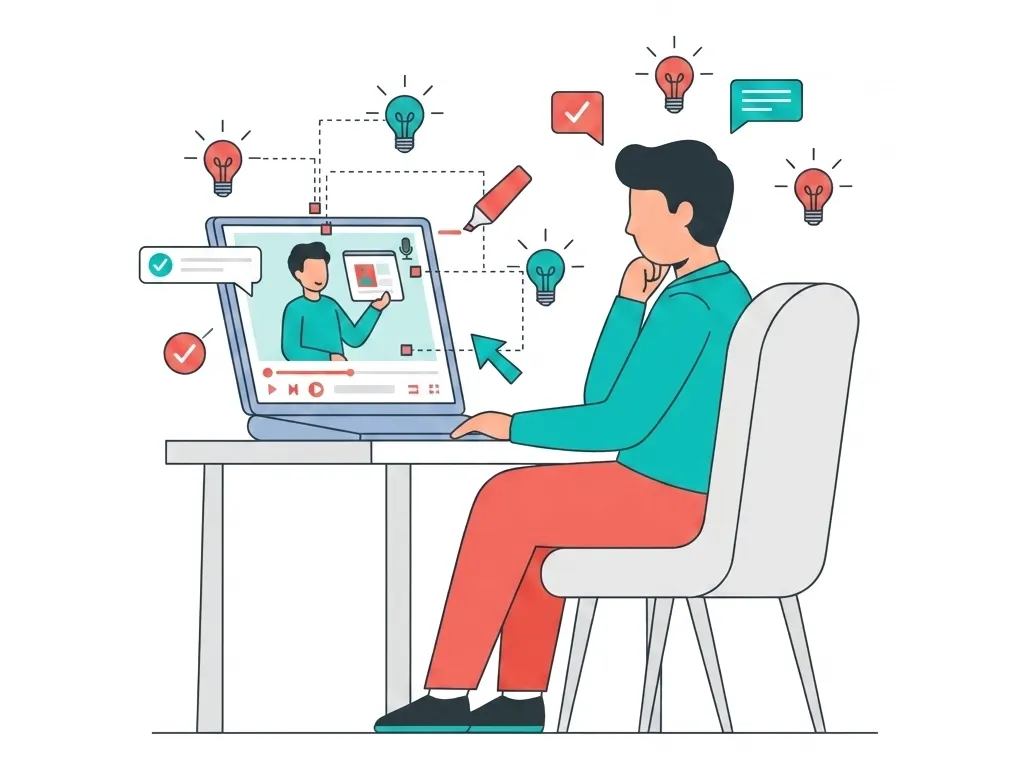
Turn Passive Video Into an Active Workspace

The lean-back problem: why "we posted the lecture" is not teaching
Recording a lecture and dropping it into the course shell feels like progress. The content is there, students can watch on their own time, and the module looks complete. But posting a video is not the same as teaching with one. Video is a lean-back medium by default. Students press play, let it run in the background, and mistake exposure for understanding. The screen fills, the minutes tick by, and very little of it turns into durable learning.

This is not a motivation problem or a generational one. It is a design problem. A plain video gives a learner nothing to do except receive. The fix is not more polish or shorter clips on their own. It is changing what the learner does while the video plays. An interactive video learning platform exists to close exactly that gap: to convert watching into doing by putting response, discussion, and self-checks directly on the timeline where the content lives.
What does the research actually reward?
Decades of learning science point to the same conclusion, and it is not "watch more." What predicts learning is the kind of cognitive work a student performs, not the volume of material they are exposed to. The ICAP framework organizes this into a ladder of engagement modes: passive, active, constructive, and interactive. Each step up asks the learner to do more with the content, and each step up tends to produce better outcomes.
A study of biology undergraduates learning from instructional videos found that the ways students cognitively engage with videos predict how they learn from them. Behaviors that signal active engagement, such as rewinding and deliberately re-watching difficult segments, positively predicted exam scores, and the authors conclude that passively watching is likely not enough to foster learning. Cynthia Brame's widely cited synthesis in CBE Life Sciences Education reaches a compatible verdict: effective video depends on managing cognitive load, maximizing engagement, and, critically, embedding video in a context of active learning through guiding questions, interactive elements, and associated assignments. Brame also notes that students who received questions interpolated into a video took more notes and reported the session as less mentally taxing.
The context around the video matters too. Research on active learning with online video shows that the learning context shapes how engaged students actually are with the same footage. In other words, the video is raw material. The engagement comes from what you build around it.
Anatomy of an active video: discussions, quizzes, and notes on the timeline
An active video keeps the footage exactly as it is and adds three layers of student action anchored to specific moments.
- In-video discussion. Comments and questions attach to the second they refer to, so a confused student can ask "what does this term mean?" at 4:12 and a peer or instructor can answer in place. The conversation lives inside the content instead of drifting off to a separate forum nobody reads.
- In-video quizzes and checks. A short prompt at a pivotal moment forces a brief pause to retrieve or apply what was just explained. This is the interpolated-question effect Brame describes, turning a passive stretch into a small act of recall.
- Timestamped notes. Students capture their own thinking against the timeline, which gives them a personal, navigable study artifact rather than a page of context-free bullet points.
None of this requires re-shooting or re-editing. The layer sits on top of video you already have, whether it is hosted on YouTube, Vimeo, Kaltura, Panopto, or your LMS.
From monologue to dialogue: comments that live where they matter
The single largest shift is turning a monologue into a dialogue. When discussion is anchored to the exact second it refers to, three things change. Questions become specific, because the timestamp supplies the context. Answers become reusable, because the next cohort watching the same clip sees the thread that already resolved the confusion. And instructors get a precise map of where students struggle, since questions cluster around the parts of a video that are genuinely hard.
Compare that to a standalone discussion board. There, a student has to reconstruct the moment in prose ("around the middle of the third video, when you were talking about the graph"), the instructor has to reconstruct it too, and by the time the answer lands the momentum is gone. Contextual comments remove that friction, which is why more of them actually get written.
Making it stick: self-checks that support retrieval, not just playback
Retrieval practice, the act of pulling information out of memory rather than reviewing it, is one of the most reliable ways to make learning durable. A plain video offers almost no retrieval. A well-placed in-video check offers a lot of it, and at very low stakes. The point is not to grade every pause. It is to make the student generate an answer before the explanation continues, which is exactly the constructive behavior the engagement ladder rewards. Notes do similar work: writing something in your own words at the moment it matters is generative, not passive.
A review of interactive video in online settings similarly reports that interactive video increases student engagement relative to non-interactive playback. The mechanism is consistent across all of this work: give the learner something to do, and they do more than watch.
What instructors see change first
Instructors who add an active layer tend to notice the same early signals. Participation rises because responding is now one click inside the video rather than a trip to a separate tool. Questions get sharper and arrive earlier, because the timeline makes it easy to point at the exact source of confusion. And completion signals improve, since a video that asks for input is harder to abandon halfway than one that simply plays to an empty room.
These are also measurable. Instead of a view count that tells you a file was opened, an engagement analytics view shows where attention holds, where students drop off, which moments generate questions, and who has gone quiet. That is the difference between knowing a video was played and knowing whether it worked.
Getting started without rebuilding your course
You do not need to redesign a syllabus to make video active. A practical first pass looks like this:
- Pick one video students already have to watch this term.
- Add two or three in-video questions at the moments that historically confuse people.
- Post one discussion prompt anchored to a spot worth debating, and reply to the first few threads yourself so students see it is a real conversation.
- Ask students to leave one timestamped note with a question they still have.
That is a single video, an afternoon of setup, and no new footage. The lecture is the same. What changes is that students stop leaning back and start doing the work the research says produces learning. Video was never the problem. Watching was. An active layer is how you fix it.
Keep reading
Related: How Annoto Transformed Dr. Iliana Portaro's Spanish Courses at Souther, Amsterdam University of the Arts: Practicing Course Material Interacti, and Video Engagement Analytics 101: Measuring What Matters.
New to Annoto? Start with What is Annoto?, or see it inside your LMS: Canvas, Moodle, Blackboard, and Brightspace.