Assessing Nursing Simulation Videos: A Faculty Workflow

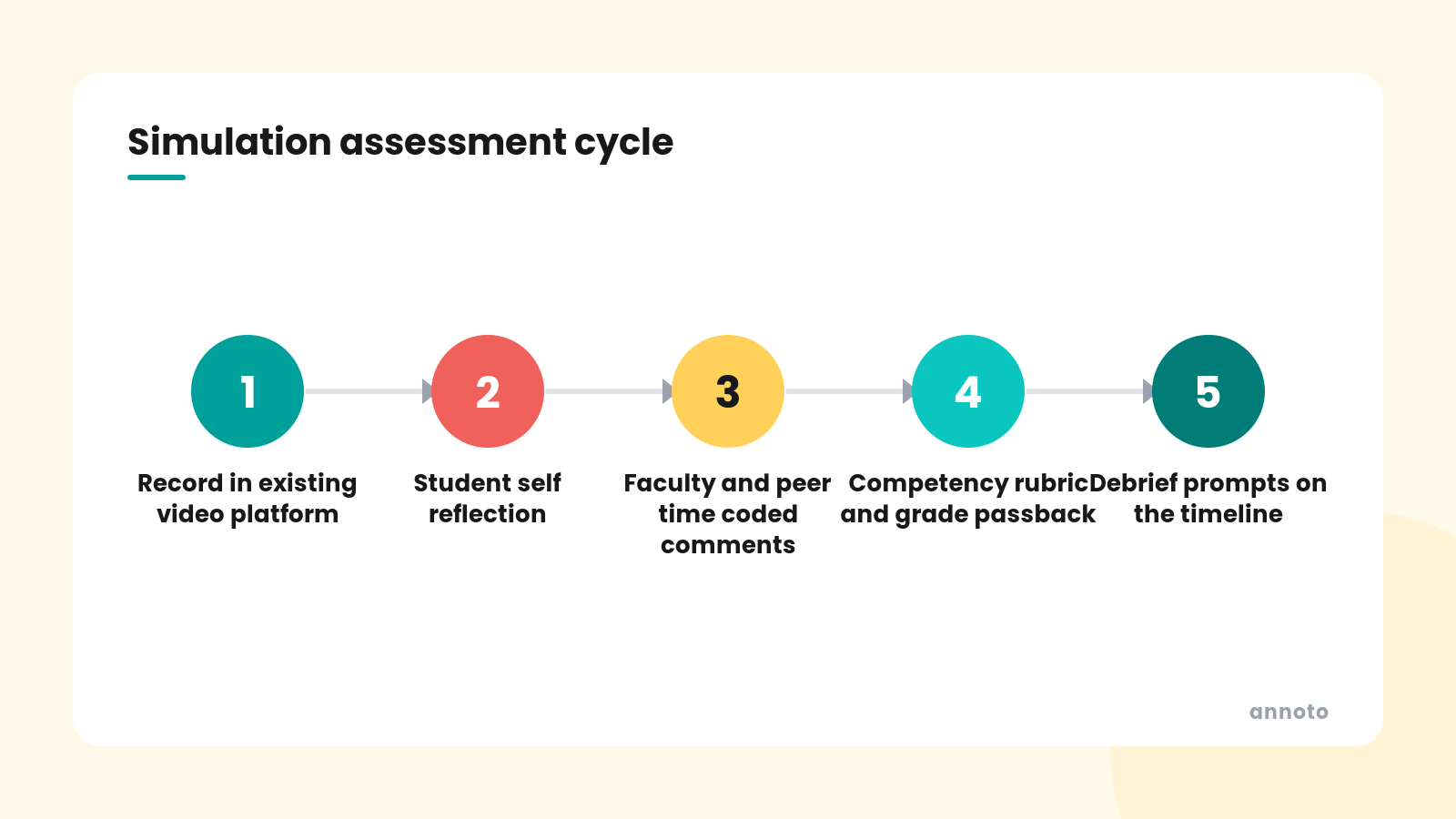
How should faculty assess nursing simulation and clinical skills videos? The workable answer is a repeatable cycle: record the sim in the video platform the school already uses, have the student review their own recording first, add faculty and peer comments at the exact moments where a competency was met or missed, score against a rubric mapped to program competencies, and close with structured debrief prompts. GoReact describes a similar model for nursing; this post shows how to run the cycle on recordings already in Kaltura or Panopto.
What dedicated video assessment tools get right
Credit first. GoReact, now part of Echo360, has made nursing education a named use case. Its GoReact for Nursing Education resource positions the product as "a reliable, objective, flexible, and secure way to assess student skill development and competency" and describes "streamlined tools for observation, assessment, and feedback" for hands on learning. That framing is correct, and a tool that pins feedback to a point in the video does those three jobs better than a paper checklist completed afterwards.
The trade offs are the ones any specialized tool carries. The recording has to be made or uploaded into the tool, it is licensed per user (as of October 2026, TrustRadius lists GoReact Education pricing at $62 per user per month with no free trial), and it runs alongside rather than on top of the video platform the simulation center already records into.

Step 1: Record once, in the platform you already have
Most simulation centers already capture sessions through lab cameras or Kaltura, Panopto or YuJa, and clinical check offs are increasingly recorded on a phone. If the file lands in the institution's video platform it inherits that platform's retention policy, access control and captioning, and faculty need no second account to review it.
Annoto runs on top of those platforms and inside the LMS, so a sim recording in Kaltura or Panopto becomes an assessable artifact without re uploading it anywhere. The video assignments workflow also accepts student uploads for skills recorded outside the lab.
Step 2: Self reflection before anyone else comments
A student who reviews their own simulation and marks the moments they would change learns more than one who reads faculty criticism cold, and faculty see the student's clinical judgment rather than only their performance. Ask students to leave three to five time coded notes on their own recording before the deadline, each tied to a prompt such as "where did you first notice the patient's status change?" Annoto's reflection points let faculty place those prompts at fixed moments in the video so the reflection is structured rather than open ended.
Step 3: Faculty and peer time coded comments
Faculty comments go on the same timeline. The discipline here is to comment on observable behavior at a moment: "at 4:32 the bed rail was left down while you turned to the computer" rather than "safety needs work."
Peer review is optional but valuable in a cohort model. A classmate who must identify two things done well and one missed cue is practicing assessment, itself a nursing competency. With peer review faculty assign reviewers, choose whether names are visible and see which students completed their reviews.
Step 4: Rubrics tied to competencies
A simulation rubric should map directly to the program's competency framework, whether that is the AACN Essentials domains, a state board checklist or the school's own clinical evaluation tool. Each criterion needs a descriptor for each level so two faculty members scoring the same video land close together. In Annoto the rubric is defined once in the assessment criteria, applied to every submission, and the score sits next to the time coded evidence, which is what accreditation reviewers ask for. The grade passes to the LMS gradebook over LTI.
Step 5: Debrief prompts that use the timeline
Simulation pedagogy treats the debrief as where the learning happens, and video turns it from memory into evidence. Rather than asking "what would you do differently?" in the abstract, the facilitator opens the recording at the moment a comment cluster shows disagreement and asks the group to reason through it. Useful prompts: what did you notice at this point, what did you expect to happen next, what would change your decision. Because comments are threaded, the debrief can continue asynchronously for students who were not in the room.
Where Annoto fits
If your nursing program wants a purpose built skills assessment tool with live review sessions and is comfortable managing a separate platform and per user licensing, GoReact is a credible option and its nursing materials are worth reading. The Annoto vs GoReact comparison sets the two side by side.
Annoto is the stronger fit when recordings already live in Kaltura, Panopto or YuJa, when faculty want self reflection, peer review and rubric scoring on the same timeline inside Canvas, Moodle, Blackboard or Brightspace, and when the school prefers an institution license that also covers lecture video quizzes and discussion across the rest of the curriculum. Per learner and per moment analytics show which segments drew the most comments and which students never reviewed their own recording, which helps identify who needs a remediation conversation before the next rotation.
Frequently asked questions
What is the best way to give feedback on nursing simulation videos?
Time coded comments tied to observable behavior, written after the student has reviewed the recording themselves, and scored against a rubric mapped to program competencies. Feedback that references a specific second of video is easier to act on than a summary written afterwards.
Can students record clinical skills on a phone and submit for assessment?
Yes. Video assignment tools accept uploads in standard formats, so a skill demonstrated at home or in an open lab can be submitted the same way as a sim center recording. Set expectations about framing and audio so the assessor can see hand placement and hear verbal checks.
How do you use video in simulation debriefing?
Open the recording at the moments that matter rather than replaying the whole session. Comment clusters and reflection responses tell the facilitator where students disagreed or hesitated, and those moments become the debrief agenda. Threaded comments let the debrief continue asynchronously.
Does GoReact work for nursing simulation?
GoReact markets a nursing education use case covering observation, assessment and feedback for hands on skills, according to its resource page. As of October 2026 it is priced per user with no free trial, so compare that to an institution licensed tool that runs on your existing video platform before deciding.
Takeaways
Assessing nursing simulation and clinical skills videos works best as a cycle: record in the platform you already have, self reflection first, faculty and peer time coded comments, a competency mapped rubric, and debrief prompts anchored to the timeline. GoReact describes a comparable model and is a reasonable choice for programs that want a standalone tool. Annoto runs the same cycle on recordings already in Kaltura, Panopto or YuJa, inside the LMS, with analytics that show who reviewed what. To see it on one of your own simulation recordings, book a walkthrough at annoto.net/demo.
