What Is AI Literacy? A Practical Framework for Higher Education
AI literacy has become the most searched phrase in education technology this year, and the least defined. Ask five institutions what it means and you will get five answers: prompt engineering workshops, academic integrity policies, tool tutorials, ethics seminars, or a line in the syllabus that says "use AI responsibly." Students, meanwhile, are not waiting. Gallup's 2026 numbers put weekly AI use among college students at 57 percent, with 21 percent using it daily. The literacy gap is not a future risk. It is the current state of the classroom.
This article offers a working definition and a practical framework an institution, a program or a single instructor can actually implement, without a curriculum overhaul and without pretending the tools can be banned away.
What AI literacy actually is
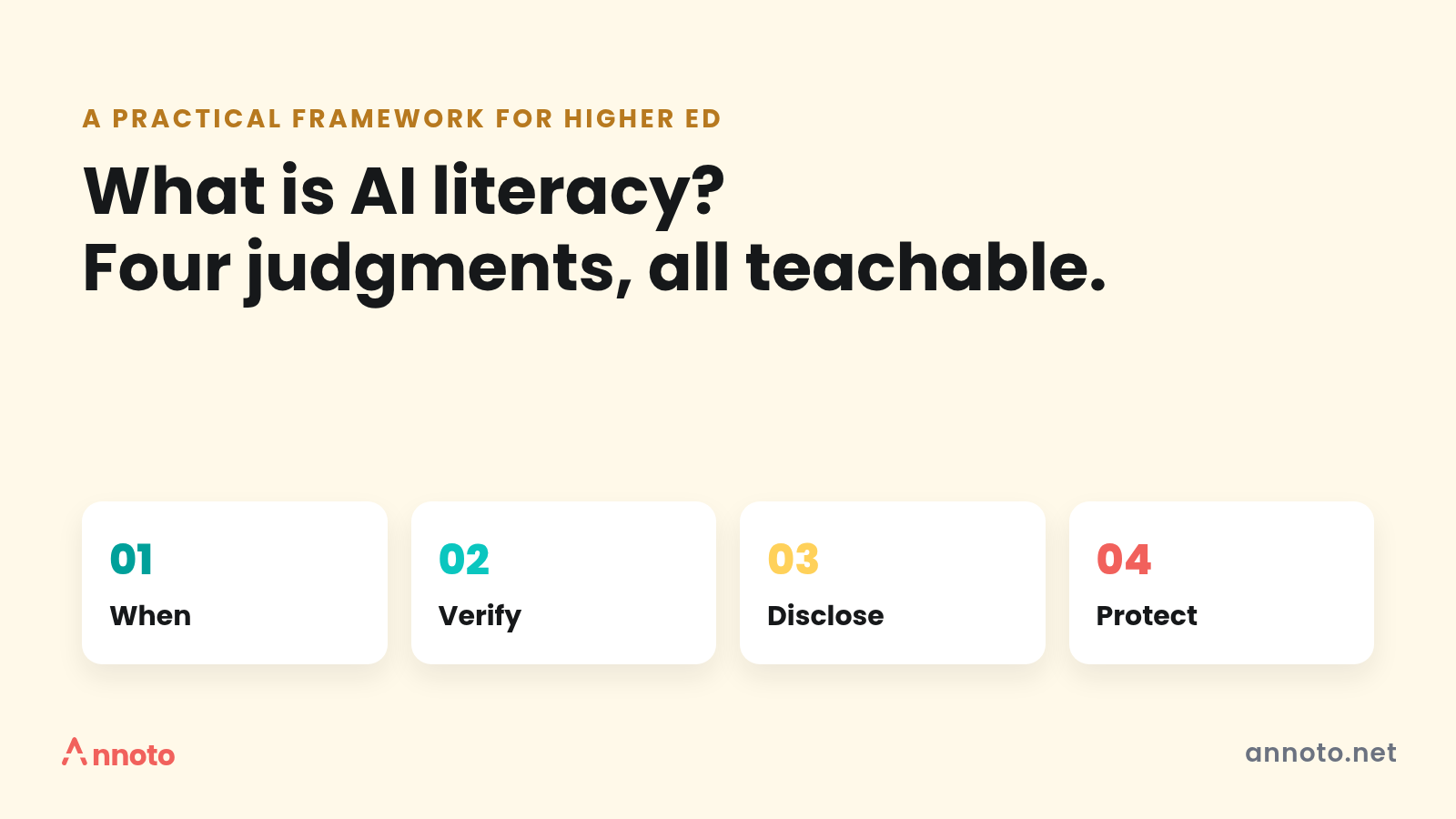
AI literacy is the ability to work with AI systems in ways that preserve and extend your own thinking. It is not primarily technical knowledge. A student does not need to understand transformer architectures any more than a driver needs to understand combustion. What they need is judgment, and judgment decomposes into four competencies that can each be taught, practiced and assessed.
Knowing when. The first competency is deciding whether a task should involve AI at all. Some tasks are green: brainstorming, clarifying a confusing concept, generating practice questions. Some are yellow: drafting with disclosure. Some are red: the assessed reasoning that is the whole point of the course. Students who cannot make this distinction do not just risk integrity violations, they risk what researchers now call cognitive offloading, outsourcing the very practice that builds the skill. We covered the evidence on that in our piece on cognitive offloading and productive struggle: performance with the tool rises while ability without it quietly falls.
Knowing how to verify. The second competency is treating model output as a claim, not an answer. Can the student check a confident assertion against the course material, a primary source, or their own reasoning? Verification is the AI-era version of citing sources, and it is almost entirely absent from current instruction.
Knowing what to disclose. The third competency is transparency: stating what the AI contributed and what the student contributed. Disclosure norms do more than protect integrity. They force the metacognitive question "what did I actually do here?", which is itself a learning event.
Knowing what to protect. The fourth competency is recognizing which parts of learning must stay human to count. First attempts, retrieval from memory, struggle with hard problems: these are not inefficiencies for AI to remove, they are the mechanism of learning. Critical AI literacy, the fastest rising variant of the search term, is precisely this: the ability to question the tool's role, not just operate it.
From definition to framework: three levels
A workable institutional framework operates at three levels, and the order matters.
Policy level: publish zones, not prohibitions. The institutions making progress have replaced vague integrity clauses with explicit zones, commonly a traffic light: green for free exploration, yellow for use with disclosure, red for think-alone work. The practical five-move version for a single course is laid out in our guide to AI literacy for students. A student who can picture the three zones argues about them far less than a student facing an ambiguous ban.
Course level: teach the competencies inside existing assignments. AI literacy fails as a standalone module because judgment only develops in context. The four competencies slot into any course: a verification assignment (grade the chatbot's answer), a disclosure habit (one line on every submission), a protected-practice structure (in-class or in-video first attempts). No new course required.
Faculty level: literacy for teachers means interrogation, not operation. Training programs that teach where the buttons are miss the point. Teachers need the same four competencies, applied to their own workflow: when AI should draft a quiz question and when it should not, how to verify generated content against what was actually taught, which decisions stay human. Our honest assessment of what AI actually helps with in teaching is a starting inventory.
Where video courses fit
Video turns out to be an ideal medium for teaching AI literacy, for one structural reason: it timestamps thinking. When a comprehension check sits inside the lecture at the moment a concept lands, the first attempt is visibly the student's own. When a question is asked and answered on the video timeline, the reasoning trail is anchored to the material, in front of peers, at a specific second. That trail is exactly the kind of process evidence we argue for in authentic assessment in the AI era: messy, contextual and hard to outsource.
In-video AI assistants add the other half of the lesson. An assistant grounded in the course that answers with a guiding question models the green zone in real time, help that makes you think, rather than thinking for you. Students experience the difference between assistance and substitution instead of just being told about it.
Practical takeaways for educators
Define AI literacy for your context in one sentence, built on the four competencies: when, verify, disclose, protect. Publish a traffic light policy this semester, even an imperfect one; clarity beats comprehensiveness. Embed one verification exercise and one disclosure habit into assignments you already run. Keep first attempts inside structures you can see, in class, in video, in discussion. And measure something: if your platform can show you answers, annotations and questions rather than just views, you can watch judgment develop over a term instead of hoping it did.
AI literacy is not a document an institution publishes. It is a set of habits a cohort develops, and this is the semester to start building them.