Do AI Tutors Improve Grades? What the New Research Shows
Do AI tutors improve grades? For two years the honest answer was "nobody has tested it properly." That excuse expired in October 2026, when two serious studies landed within weeks of each other and pointed in opposite directions. One found an AI math tutor associated with months of additional learning. The other, a true randomized trial at a flagship university, found an AI course assistant lowered grades. Read together, they are not contradictory at all. They are the clearest picture yet of when AI tutoring helps, when it hurts, and what the difference is made of.
The trial that found lower grades
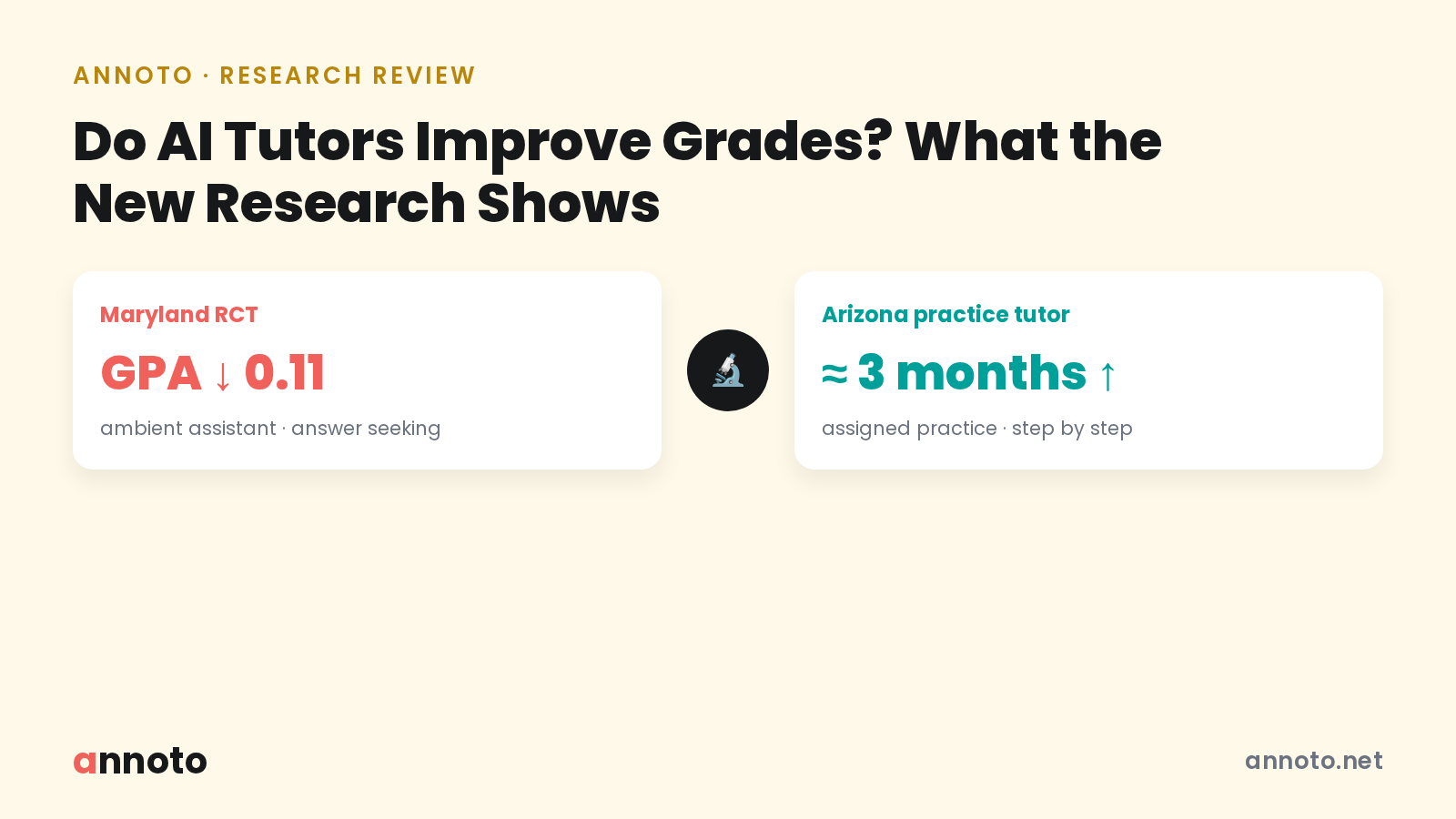
The University of Maryland ran the kind of study institutions almost never run: a randomized controlled trial requested by the provost before a campus wide rollout. In fall 2025, 15 of 30 professors added an always available AI course assistant to their classes, reaching about 1,100 students, while matched sections taught the same courses without it. The results, analyzed by the university's Center for Educational Data Science and Innovation and reported by The Hechinger Report, were sobering: students with the assistant averaged 0.11 points lower on a four point GPA scale, engaged less with course materials, and attended office hours less often. Effects were worse for first generation students.
The usage data explains a lot. Only about 15 percent of students used the assistant at all, and most who did asked it for answers rather than tutoring. The researchers suspect the assistant's constant presence also signaled that AI use was welcome, nudging students toward outside chatbots for finished answers. The university deserves real credit: it tested before rolling out to 40,000 students, and it published the negative result.
The study that found real gains
The same research director was involved in a second study with the opposite headline. About 6,000 Arizona middle schoolers used Goblins, a math practice site whose AI tutor gives step by step help. Students who practiced consistently, at least two problems a week across the year, scored significantly higher on year end standardized tests, a 0.11 standard deviation difference that the commissioning nonprofit equated to roughly three months of extra learning. The caveat is honest: this was not randomized, and motivated students may both practice more and score higher. But the design detail matters: teachers assigned the work, the tutor supported problem solving rather than replacing it, and help arrived step by step instead of as finished answers.
What separates the two results
Three differences do most of the work. First, integration versus access: Goblins was woven into assigned practice, while Maryland's assistant was an open door most students never walked through, and the ones who did wanted answers. Second, tutoring versus answering: one tool scaffolded steps, the other would hand over solutions on request. The cognitive science behind that distinction is the whole story of productive struggle: learning lives in the effortful middle that answer engines delete. Third, the teacher stayed in the loop in Arizona, assigning, pacing, and seeing results, which is the same pattern that separates help from hype across AI in teaching generally.
What this means before you deploy one
The lesson is not "AI tutors fail." It is that deployment design, not model quality, decides the outcome. The questions that now have evidence behind them: Is the tutor grounded in your actual course, or the open internet? Does it guide reasoning or vend answers? Is it embedded where the work happens, or parked in a sidebar? Who sees the usage data, and would anyone notice if it taught nothing? Our five question checklist for AI tutors expands each one.
Embedding matters more than most procurement conversations admit. A tutor that lives inside the course video, like Lumo, meets students at the exact moment of confusion, answers from the course material itself, and shows instructors a minute by minute map of where the class is stuck. That is the Arizona pattern, not the Maryland one: integrated into real work, grounded in real content, teacher in the loop.
Measure, because averages hide everything
Maryland's averages conceal a spread: some students surely used the assistant well. The practical move for any institution piloting AI tutoring is to instrument it: watch engagement signals alongside grades, compare cohorts, and check who the tool serves worst, since the Maryland effects concentrated among first generation students, the group with the least slack to absorb a bad tool. Our engagement analytics primer covers the signals worth tracking.
Practical takeaways
Pilot with a control group before any rollout, the way Maryland did. Choose tutors that scaffold rather than solve, grounded in course content. Embed them in assigned work rather than offering ambient access. Keep teachers assigning and reviewing. And treat AI literacy, knowing when and how to use the tutor, as part of the course, not an assumption about students. The research no longer says AI tutors are the future or a failure. It says they are a design problem, and the design is finally legible.