AI in Higher Education in 2027: Five Shifts Every Campus Will Feel
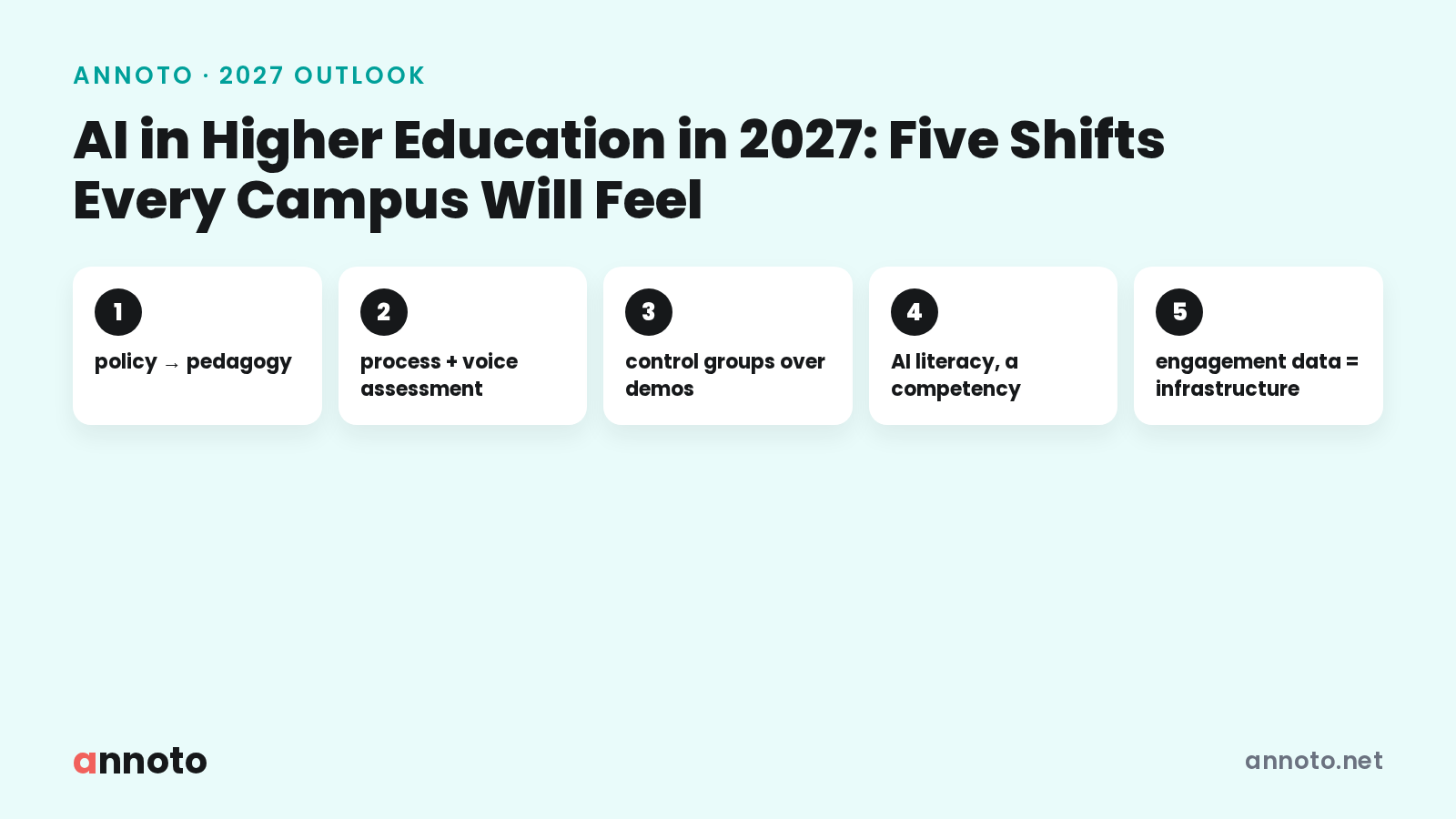
"AI in higher education" has become one of the most searched phrases in the entire education category, which tells you where every strategic conversation on campus now starts. EDUCAUSE's Top 10 for 2027 frames the moment as an age of change, and the framing fits: the questions have moved from whether AI belongs on campus to how teaching, assessment, procurement and student support reorganize around it. Here are the five shifts we believe every institution will feel by the end of 2027, and what to do about each one while there is still room to be early.
1. From AI policy to AI pedagogy
The policy era produced syllabus clauses and integrity statements. The pedagogy era asks a harder question: what should students practice, now that fluent text is free? The institutions moving fastest have stopped legislating tool use in the abstract and started redesigning activities so the thinking is visible: structured discussion anchored to course material, comprehension checks inside lectures, work that leaves a timestamped trail. The design principles are the subject of our guide to authentic assessment in the AI era.
2. Assessment moves toward process and voice
The polished essay now proves access to a tool. What still proves understanding is the process: the question asked at minute 12, the position defended against a classmate, the explanation in the student's own words under follow up. Expect two formats to keep rising through 2027: process based assessment built on engagement evidence, and the return of the oral exam, made scalable by asynchronous video workflows we describe in scaling oral assessment with video. Medical education, which never abandoned verification, is suddenly the model everyone else is borrowing from.
3. Procurement grows up: evidence replaces demos
October 2026 gave higher education a landmark: the University of Maryland randomized its planned AI assistant rollout and found it lowered grades and participation, a result covered in detail in our analysis of whether AI tutors improve grades. The precedent matters more than the finding. Provosts now have a template: pilot with a control group, measure learning rather than satisfaction, publish what you find. Vendors should expect "show me your evidence" to replace "show me your demo," and the tools that thrive will be the ones instrumented well enough to answer. Interoperability baselines like LTI 1.3 Advantage become table stakes in the same conversations.
4. AI literacy becomes a graduation competency
With the large majority of students already using AI weekly, institutions are converging on AI literacy as a learning outcome rather than an orientation module: knowing when to use AI, how to verify what it says, what to disclose, and which parts of learning to protect from it entirely. The framework we published on what AI literacy actually means in higher education argues all four judgments are teachable inside existing courses, no curriculum overhaul required. By 2027, expect accreditors and employers to start asking how programs evidence it.
5. Engagement data becomes core infrastructure
Retention economics are unforgiving, and the signals that predict attrition appear in week one viewing behavior, weeks before any grade exists. As budgets tighten, the early warning layer stops being an analytics luxury and becomes infrastructure, the same way the LMS did. The playbook, from which signals matter to what a two minute intervention looks like, is in spotting at risk students before week three. The institutions that pair AI features with engagement measurement will also be the only ones able to tell whether their AI investments teach anything, which closes the loop with shift three.
What stays constant
None of these shifts replace teachers. Every durable pattern in the research points the same way: AI that amplifies instructor judgment helps, AI that substitutes for student effort hurts. The lecture becomes a conversation, the data becomes a prompt for human outreach, the assistant answers from the course rather than around it. Higher education's AI transition will be judged not by how much technology campuses adopted, but by whether learning stayed the point.
Practical takeaways
Audit one program's assessments for AI resilience before fall 2027. Stand up a pilot protocol with control groups for any student facing AI tool. Name AI literacy in learning outcomes and map where each judgment is taught. And instrument engagement now, because every other shift depends on being able to see what students actually do. The age of change rewards institutions that can measure it.