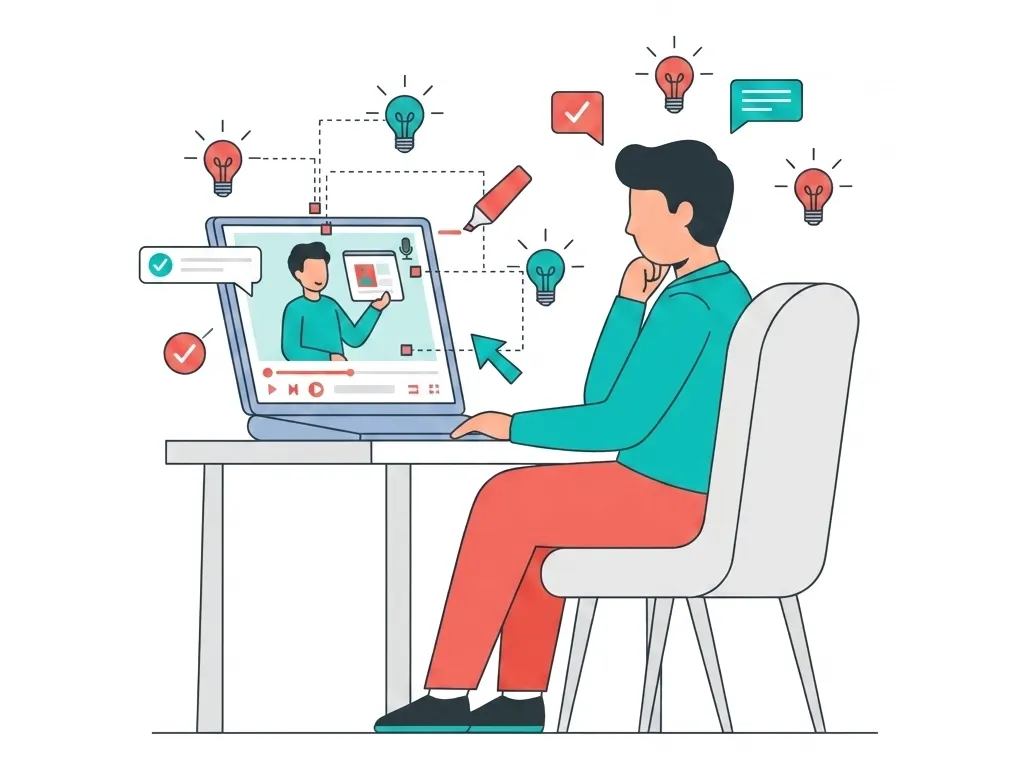
Accessibility Is Engagement: UDL and Inclusive Video Learning
Accessibility often gets filed under compliance: a box to check, a captioning requirement to satisfy, a legal risk to manage. That framing is not wrong, but it is small. When you look at accessible video learning through the lens of Universal Design for Learning, something more interesting appears. The practices that make content usable for learners with disabilities tend to make it better for everyone. Accessibility, done well, is just good teaching, and good teaching drives engagement.
UDL reframes the whole question
Universal Design for Learning starts from a simple observation: learners vary, and there is no single average student to design for. Rather than retrofitting accommodations onto a rigid course, UDL builds in flexibility from the start across three principles, multiple means of engagement, representation, and expression. The goal is not to lower the bar. It is to remove the incidental barriers that have nothing to do with the actual learning objective.
Video is where these principles get concrete, because a single video can either exclude a lot of people or include almost all of them, depending on how it is designed.
Representation: more than one way in
Multiple means of representation means not relying on a single channel. Captions are the obvious example, essential for deaf and hard-of-hearing learners, and also quietly used by people in noisy environments, non-native speakers, and anyone who reads faster than they listen. Transcripts, clear visuals, and the ability to revisit a segment all give learners more than one route to the same idea. This is also the territory of WCAG 2.1 AA, the widely adopted standard covering captions, contrast, keyboard access, and more.
- Captions and transcripts for every video.
- Sufficient color contrast and readable on-screen text.
- Full keyboard operability, not mouse-only interaction.
- The freedom to pause, rewind, and re-watch at the learner's own pace.
Engagement and expression: many ways to participate
The other two principles are where interactive video shines. Multiple means of engagement means offering more than one way to stay invested, and multiple means of expression means more than one way to respond. A learner who would never raise a hand in a lecture hall might write a thoughtful comment on the video timeline. Another might prefer to answer a quick embedded question, or record their thinking in a note. None of these is the correct way; together they let more learners participate as themselves.
Inclusion and engagement are the same goal
This is the quiet thesis: the flexibility that makes learning accessible is the same flexibility that makes it engaging. When learners can choose how they take content in and how they show what they know, more of them lean in. Annoto is built with this in mind, layering captioned, keyboard-accessible interaction, in-video questions, discussion, and notes onto video, and integrating through one-click LTI 1.3 into Canvas, Moodle, Blackboard, or Brightspace so inclusive design lives inside the courses learners already use.
The takeaway: stop treating accessibility as a separate, grudging workstream. Design with UDL and WCAG 2.1 AA from the outset, give learners multiple ways to engage and respond, and you will find that inclusion and engagement were never two goals. They were always one.
Where to start this term
Begin with an audit rather than a policy. Pick the three most-watched videos and check them against the basics: accurate captions, a transcript, readable on-screen text, and interaction that works without a mouse. Fixing your highest-traffic content first delivers the widest benefit for the least effort.
Then widen participation deliberately. For each video, offer at least two ways to respond, an embedded question plus an open comment thread, and note who shows up in each channel. Instructors are often surprised by how many previously silent learners appear once a lower-pressure option exists — the UDL argument made visible in your own data.
Keep reading
Related: Microlearning Meets Video: Short Clips That Actually Stick, Talpiot MOOC: Substantive Group Discussion At Scale On Open edX, and What Is Annoto? The In-Video Engagement Layer, Explained.
New to Annoto? Start with What is Annoto?, or see it inside your LMS: Canvas, Moodle, Blackboard, and Brightspace.