Talpiot MOOC: Substantive Group Discussion At Scale On Open edX

The Introduction to Multiculturalism and Cultural Diversity course was designed to create a unique, active learning experience — using cutting-edge technology together with collaborative learning to make students from different cultures and ethnic groups not just learn about multiculturalism, but actually experience it.
At a glance
- Platform: Campus IL (Israel’s National Digital Learning Initiative), powered by Open edX
- Integration: Annoto xBlock
- Course type: MOOC (self-paced)
- Use case: Collaborative Learning, Assessments
- Languages: Arabic, Hebrew, English
- Recognition: Reimagine Education award
About the course
The course uses virtual worlds (VW) and collaborative online learning not just to understand cultural diversity, but to experience complex issues related to our lives — identity, culture, prejudice, and stereotypes — thus reducing racism and building empathy. Students first build knowledge by sharing experiences, then experience the issues through simulations and role-plays in the virtual world. Learners are introduced to the academic material through interactive animated videos within their small group, and then reflect on the process. The course operates on Campus IL, powered by Open edX, and its target audiences are students at academic institutions, employees in social sectors, and the public at large.
Annoto in the course
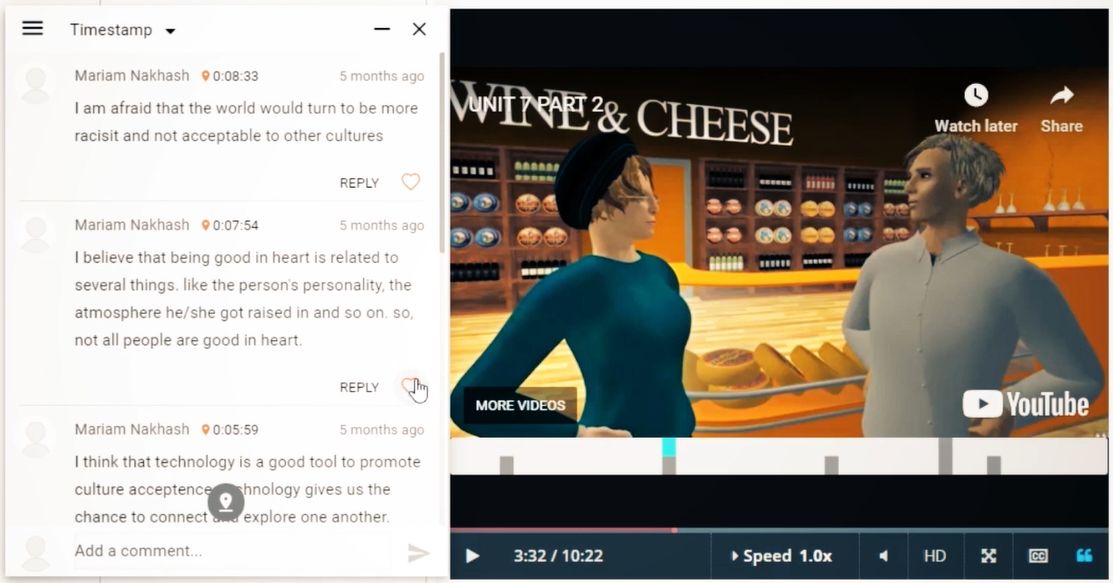
Annoto was an integral part of the course, enabling learners to build knowledge by sharing experiences — based on a variety of situations presented to them in the video content. This created an active learning experience and helped students develop empathy toward fellow students from other cultures.
Analytics and insights
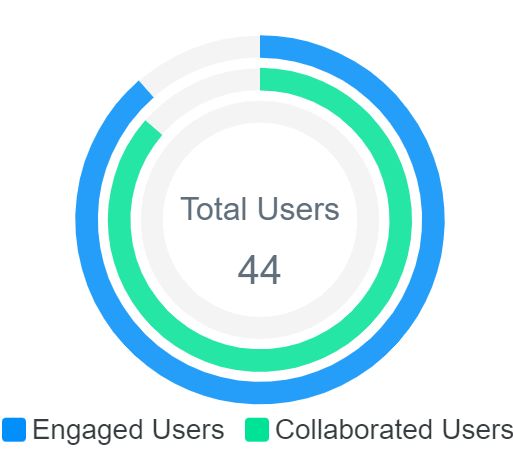
The Annoto Dashboard provided cohort-based insights into students’ participation in sharing their experiences, and how it engaged their fellow students. It also let the team track student progress and assignment completion. 88% of the students collaborated — asking questions, replying to others, and sharing thoughts and insights — and that activity drove 91% of users to get engaged in the video.
What students said about the course
“The use of technology helped communicate an educational message. It made the material more interesting, more experiential, and I believe that when the material is more interesting, it succeeds in ‘touching’ the student more, and thus the material is acquired and remembered.”
“I did not think I would be so excited about learning.”
What the course architects said

Annoto allowed students to engage in substantive questions in groups. The sharing of responses and the attitude of group members towards each other contributed to an understanding of the material and a deepening of important issues, thus leading to directions of thinking that encourage cultural competence.
— Dr. Ilan Nagar, Techno-pedagogue

Watching videos can be a lonely experience. Using Annoto made the students become active and reflect on the material and ideas being presented. We were able to develop the students’ empathy to the other through this.
— Dr. Elaine Hoter, Project Leader
Takeaways for MOOC and Open edX Teams
This course succeeded on terrain where discussion usually dies: a self-paced MOOC with learners spread across languages and cultures. The design lesson is that prompts asking for lived experience outperform prompts asking for right answers. When a scenario invited students to describe how a situation looked from inside their own culture, every learner had something only they could contribute, and the thread became part of the course content rather than a chore beside it.
Self-paced also does not have to mean solitary. Because every exchange is anchored to a moment in the video, a learner who arrives weeks later lands inside the conversation earlier participants left behind, reads perspectives unlike their own, and adds to them. Asynchronous pacing stops being the enemy of collaboration and becomes the thing that lets it accumulate.
For platform teams, the practical notes are short. The xBlock drops Annoto into an existing Open edX course without rebuilding it, and the cohort-level dashboard shows which groups are talking and which need a nudge. If your catalogue includes a sensitive-topic course, pair one scenario video with one experience-sharing prompt and watch what the cohort does with it.
Keep reading
Related: WashU: Boosting Peer Review With Time-Tagged Discussion, What Is Annoto? The In-Video Engagement Layer, Explained, and Accessibility Is Engagement: UDL and Inclusive Video Learning.
New to Annoto? Start with What is Annoto?, or see it inside your LMS: Canvas, Moodle, Blackboard, and Brightspace.