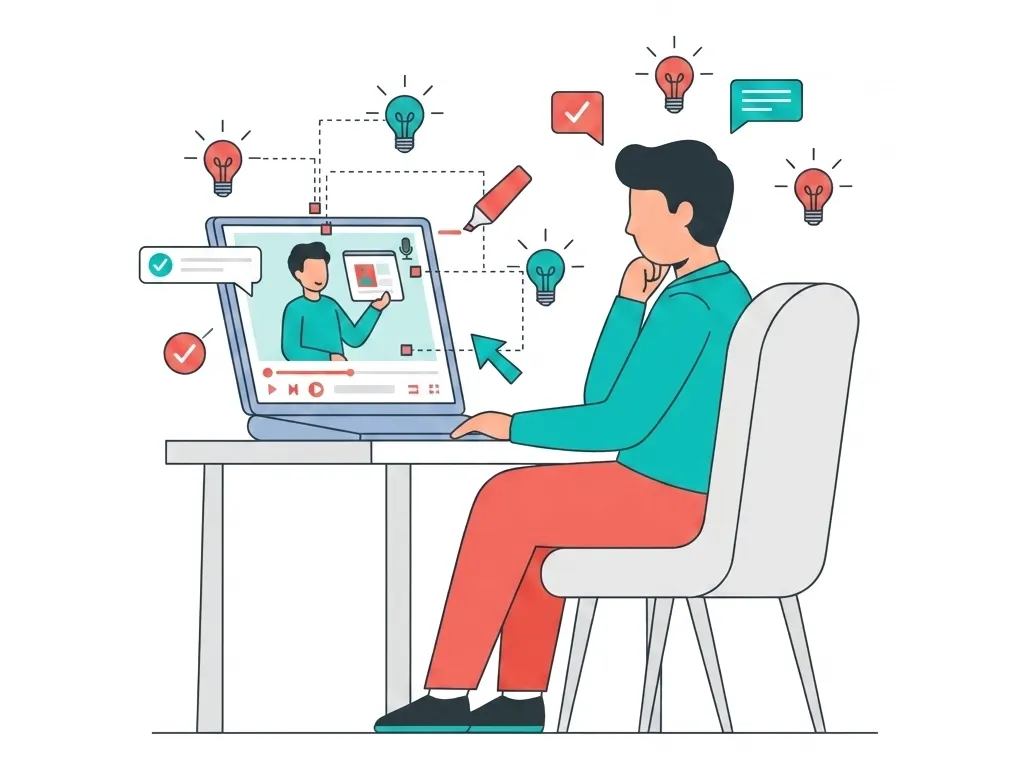
Microlearning Meets Video: Short Clips That Actually Stick
Microlearning is having a moment, and the appeal is obvious. Short, focused clips fit into a busy day, respect limited attention, and let learners grab exactly the piece they need. But there is a catch that gets glossed over in the enthusiasm: short does not automatically mean memorable. A three-minute video is just as forgettable as a thirty-minute one if the learner does nothing but watch it. Length is not the ingredient that makes learning stick.
Short is a delivery format, not a learning strategy
Chunking content into small pieces solves a real problem, cognitive overload. Working memory is limited, and a tight clip that covers one idea is easier to process than a sprawling lecture. That is a genuine benefit. But processing something easily in the moment is not the same as retaining it, and this is where a lot of microlearning quietly fails. It optimizes for consumption and forgets about retention.
To make short content stick, you have to pair the format with the two mechanisms cognitive science keeps pointing to: retrieval practice and spacing.
Retrieval practice inside the clip
Retrieval, the act of pulling an answer out of your own memory, is one of the most reliable ways to make knowledge durable. The beauty of microlearning is that a short clip is the perfect container for it. One idea, then one question that forces the learner to recall and apply it. Interactive video makes this seamless: the clip pauses, the learner commits to an answer, and the effort of retrieval encodes the concept far better than passive viewing ever could.
- End each clip with a question that demands recall, not recognition.
- Ask learners to apply the idea to a quick scenario, not just restate it.
- Invite a short note or reflection so they put the concept in their own words.
Spacing turns clips into a curriculum
The second mechanism is spacing. Reviewing material across spread-out sessions beats cramming it into one, and microlearning is naturally suited to it. A series of short clips revisited over days or weeks, each reintroducing and building on the last, produces far more durable learning than the same content binged in a single sitting. The short format is what makes that rhythm sustainable.
Works on campus and at work
This combination, short clips, embedded retrieval, and spacing, travels well. A university student reviews concept clips across a semester; a sales rep refreshes product knowledge in five-minute bursts between calls. In both cases the design principle is identical, and the outcome is the same: retention instead of a pleasant sense of having watched something.
This is the model Annoto supports. In-video questions turn each clip into a retrieval moment, notes prompt reflection, and the whole experience drops into Canvas, Moodle, Blackboard, or Brightspace with one-click LTI 1.3 so a spaced sequence of clips lives right inside the course or training path.
The takeaway is worth remembering: microlearning does not stick because it is short. It sticks because short clips make it easy to build in retrieval and spacing. Design for those, and small pieces add up to lasting knowledge.
Putting it into practice
Most teams do not need new footage to start. Take one existing lecture or training video, mark its natural concept boundaries, and cut it into clips of three to six minutes, each closing with a single recall question. The editing effort is modest, and the source material already exists.
Then schedule the sequence deliberately. Release clips across the weeks a course or onboarding path already spans, and reopen an earlier question inside a later clip so the spacing happens by design rather than by learner discipline.
Finally, watch two numbers: completion per clip and first-attempt accuracy on each question. Falling completion signals a clip that runs long; low accuracy marks a concept that deserves its own follow-up clip.
Keep reading
Related: Active Learning at Scale: Engaging Large Cohorts Without Burning Out F, WashU: Boosting Peer Review With Time-Tagged Discussion, and Annoto for Open edX: The Engagement, Assessment, and Insight Layers Vi.
New to Annoto? Start with What is Annoto?, or see it inside your LMS: Canvas, Moodle, Blackboard, and Brightspace.