Generative AI in Education: Examples That Actually Improve Learning
Generative AI stopped being a novelty in education somewhere between the first chatbot syllabus ban and this semester's institution wide AI assistant rollouts. The term now covers everything from a teacher drafting a rubric in ChatGPT to a university embedding a tutoring assistant in every course. That breadth is exactly why "generative AI in education" is one of the fastest rising searches in the category: educators are not asking what the technology is anymore. They are asking what it is actually good for. This guide collects the examples that hold up in real courses, and the pattern that separates them from the ones that quietly undermine learning.
The pattern behind the examples that work
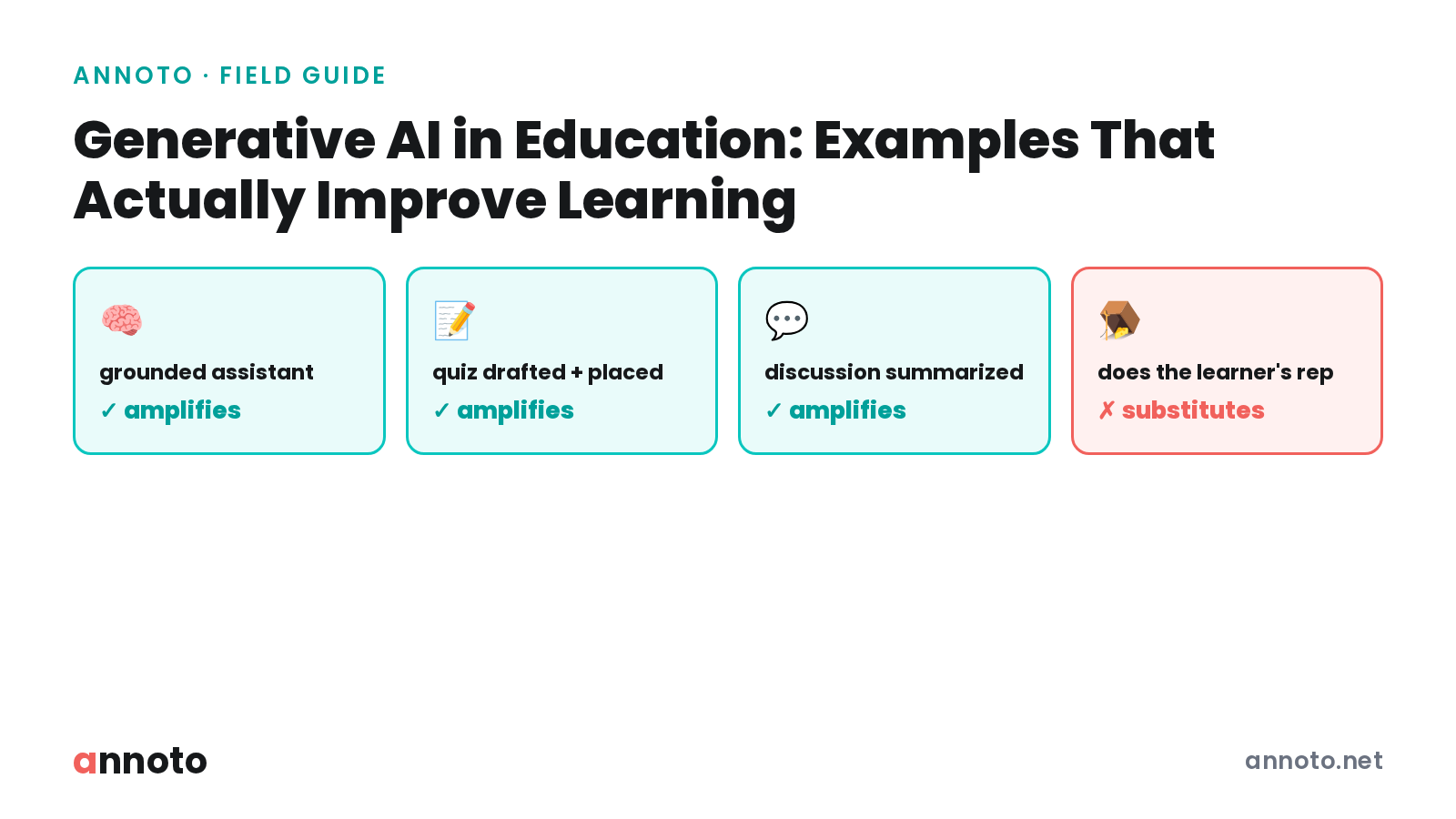
A useful test runs through every example below: generative AI improves learning when it amplifies the teacher's judgment or deepens the student's effort, and it damages learning when it substitutes for either. A randomized trial at the University of Maryland made this concrete in October 2026: students given an always available AI course assistant earned slightly lower grades and engaged less with course materials, largely because most of them used it to get answers rather than tutoring. The technology was fine. The design put it on the wrong side of the line.
Examples that improve teaching
1. Drafting quiz questions anchored to real content
Generative AI writes plausible quiz questions in seconds. The versions that improve learning are grounded in the actual lecture, reviewed by the instructor, and placed where students struggle rather than at arbitrary intervals. Our guide to AI generated quizzes covers the craft: the data picks the spot, AI drafts the question, the teacher decides.
2. Summarizing discussion before office hours
An instructor with two hundred timeline comments on a lecture video cannot read them all before class. AI summarization turns that stream into "the cohort is confused about minute 12 and the second worked example," which changes what the instructor does next. This is AI reclaiming teacher hours, the theme of what actually helps in AI for teaching.
3. First pass feedback with the teacher keeping the grade
Generative AI drafts formative feedback on practice work well, and research says to keep it away from summative scores. The deployment rule that survives the evidence: AI drafts, humans decide, and the stakes set the ratio.
Examples that improve studying
4. Course grounded assistants instead of open chatbots
Students already ask AI their stuck questions. The design choice is whether answers come from the open internet or from the course itself. Assistants grounded in the actual lecture material, like Lumo inside the video player, answer at the moment of confusion and show instructors a map of where the class is struggling. The difference between this and a generic chatbot is the difference between a teaching assistant who attended the lecture and a confident stranger.
5. Socratic practice, not answer vending
The AI tutors worth deploying respond to "what is the answer" with a better question. Before adopting one, put it on a two axis map: does it know your course, and does it guide reasoning or hand out solutions? Our guide to AI tutors in higher education gives a five question checklist.
6. Language and accessibility support
Generative translation, captioning and plain language rewrites remove barriers for English learners and students with disabilities without touching the intellectual work of the course. These are the least glamorous examples and among the best evidenced.
Examples that improve course design
7. Generating comprehension checks for existing video
Most institutions sit on large passive video libraries. Generative AI lowers the cost of converting them into active experiences: draft questions for each segment, review, embed. The research case for doing this is laid out in our piece on video comprehension checks.
8. Simulating students to stress test materials
Asking a model to attempt your assignment reveals ambiguities, and asking it to answer your exam reveals which questions a chatbot can clear, which is now essential information for designing assessment in the AI era.
The examples that backfire
The failure cases share one shape: the AI does the rep instead of the learner. Essay generation submitted as evidence of learning, solution steps delivered before the struggle, summaries that replace the reading rather than check it. The cognitive science here is unambiguous, and we cover it in cognitive offloading and productive struggle: the difficulty is not an obstacle to learning, it is the mechanism.
Practical takeaways
Start with teacher facing uses, where the evidence is strongest and the risk lowest. Ground any student facing assistant in your course content, never the open internet. Measure engagement before and after, because usage data tells you quickly whether a tool deepens effort or replaces it. And run the one question test on every feature: does this amplify judgment and effort, or substitute for them? The institutions getting value from generative AI in 2027 are not the ones that adopted the most tools. They are the ones that kept asking that question.