Active Learning at Scale: Engaging Large Cohorts Without Burning Out Faculty
Active learning is easy to love in a seminar of twenty students and easy to abandon in a lecture hall of two hundred. The techniques that make small classes hum, discussion, questioning, immediate feedback, seem to demand a teacher-to-student ratio that large and asynchronous courses simply do not have. So faculty default to the lecture, the cohort goes quiet, and everyone accepts disengagement as the price of scale. It does not have to be that way.
The scale problem is a logistics problem
The reason active learning breaks down at scale is rarely pedagogical. Instructors know that retrieval, discussion, and feedback work. The obstacle is logistics: you cannot personally prompt, hear, and respond to two hundred people, and in an asynchronous course you are not even in the room at the same time. The goal, then, is not to work harder. It is to redesign where the interaction happens.
The most effective move is to shift active learning into the content itself, so engagement does not depend on the instructor being present at the moment of learning.
In-video interaction does the heavy lifting
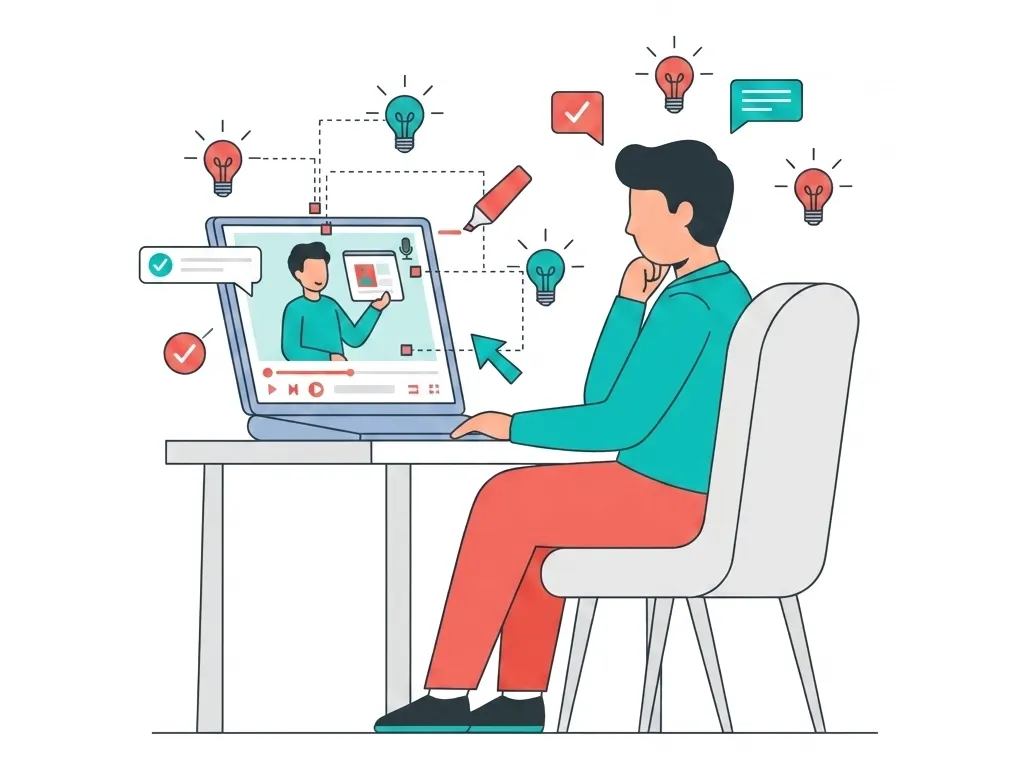
When questions, discussion, and notes live inside the video, every learner engages on their own schedule and still does the active work. A student in a 200-person async course answers the same embedded question, joins the same threaded discussion, and reflects in the same margin as a student in a small seminar. The cohort size stops determining whether learning is active.
Peer interaction scales especially well. In a large discussion thread anchored to a specific moment in the video, students answer each other's questions, and the best explanations often come from peers, not the instructor. The larger the cohort, the richer that shared discussion can be.
Let TAs and analytics target the effort
Faculty time is the scarce resource, so spend it where it matters. Two mechanisms make that possible:
- TA moderation: teaching assistants triage discussion, surface recurring questions, and answer in one place where the whole cohort benefits.
- Analytics that flag where to intervene: instead of monitoring everyone, the instructor sees which segments confuse the cohort and which students have gone silent, and acts precisely there.
Sustainable, not heroic
The point of this design is that it does not run on faculty heroics. Active learning at scale should reduce the instructor's cognitive load, not multiply it. Annoto is built for exactly this: in-video questions and discussion carry the engagement, TA moderation keeps threads manageable, analytics direct attention to the students and moments that need it, and one-click LTI 1.3 into Canvas, Moodle, Blackboard, or Brightspace means none of it lives outside the course.
The takeaway for anyone teaching large or asynchronous cohorts: stop treating active learning as something you personally perform in real time. Build it into the content, let peers and TAs share the load, and let analytics tell you where to spend the attention only you can give. That is how engagement scales without the burnout.
A first-semester rollout plan
Moving a large course to this model works best as a staged experiment rather than a redesign. In the opening weeks, embed two or three questions in each required video and seed one discussion prompt at a moment students typically misunderstand. Keep grading stakes low; the aim is to make responding feel routine before it counts.
By mid-term, review the analytics with your TAs. Look for segments with heavy rewatching, questions with low first-attempt success, and learners with no activity for two weeks, then assign each TA a slice of the cohort to follow up with. This turns moderation into a defined weekly task instead of an open-ended chore.
Close the loop at semester’s end by comparing completion and participation against the previous run. Concrete before-and-after numbers are what convince skeptical colleagues that the model deserves to spread.
Keep reading
Related: Closing the Skills Gap: Video Training Corporate L&D Can Actually Meas, Florida State University: Creating An In-Person Feeling In Asynchronou, and ADA Title II 2027: Making Your Video Content Accessible in Time.
Go further: Why Passive Video Fails (and What Active Learning Fixes) covers the pedagogy behind this design, and Lumo, Annoto's AI copilot, drafts the in-video questions and summaries so scale does not mean more instructor work.
New to Annoto? Start with What is Annoto?, or see it inside your LMS: Canvas, Moodle, Blackboard, and Brightspace.