Flipped, Async, or Blended: Annoto Fits How You Already Teach
Most edtech asks you to rebuild your course around the tool. We prefer the opposite. Whether you flip your classroom, teach fully asynchronously, or blend live and online time, the lecture video you already recorded can stay exactly where it lives. Annoto layers engagement on top of it, right inside Canvas, Moodle, Brightspace, or Blackboard, so the modality is your choice and the setup never changes.

Flipped: Turn Pre-Class Watching Into Pre-Class Thinking
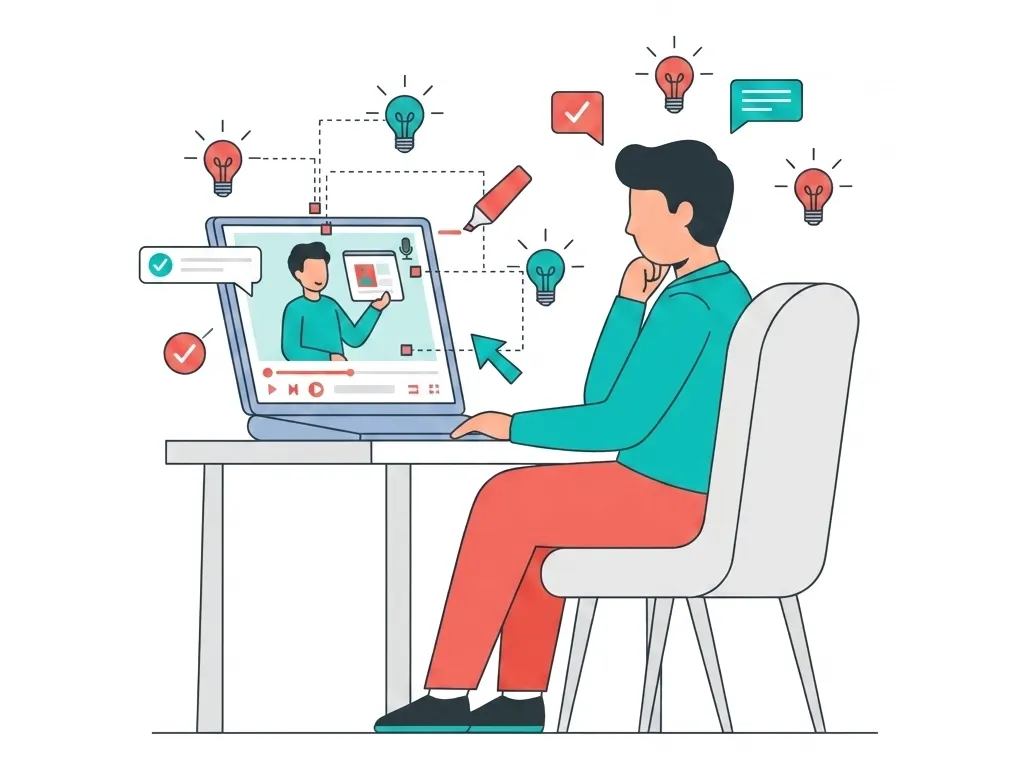
In a flipped model, the video only works if students arrive having actually engaged with it. We embed in-video quizzes, reflection points, and comments directly in the timeline, so watching becomes doing. Lumo, our AI copilot, can auto-generate those quiz checks and scaffold them across Bloom's taxonomy, so recall questions early give way to application by the end. Before you walk into class, the analytics tell you where comprehension dipped and which passages sparked the most discussion, so your face-to-face time targets what students genuinely found hard.
Asynchronous: Keep the Cohort Present When No One Is Live
Fully online courses lose the room. We give it back by anchoring discussion to specific moments in the video, so a question about minute twelve lives at minute twelve, and every learner who reaches it joins the same conversation. Peer review and reflection prompts turn solitary viewing into collaboration on your schedule, not the clock's. Two things happen automatically:
- Every timestamped comment, quiz attempt, and reply documents Regular & Substantive Interaction for compliance.
- Quiz results sync straight to the LMS gradebook, so assessment is built in rather than bolted on.
Blended: One Continuous Thread Across Every Format
Blended teaching moves between live and independent time, and the video is often the connective tissue. Because the engagement layer travels with the content, a discussion that opens before class can continue after it on the very same clip. Nothing is duplicated, re-uploaded, or stranded in a separate app.
The modality changes how students meet the material. It should not change the material, the platform, or your workflow.
That is the point. One video, one LTI 1.3 connection, and the same active-learning tools whether a course is flipped this term and blended the next. We meet you where you already teach.
What adoption looks like over a term
The practical sequence is short. An LMS administrator installs the LTI 1.3 connection once — Canvas, Moodle, Brightspace, Blackboard, and Open edX all follow the same pattern, and LTI 1.1 remains supported for older environments. From that point, individual instructors decide course by course whether to switch the layer on. There is no student rollout to manage: learners open the same video page they always have, inside the LMS session they are already signed into, and the discussion and quiz layer is simply there.
A sensible pilot starts with a single high-enrollment course and its two or three most-watched recordings. The instructor seeds a few timestamped prompts, drops one comprehension check into each video, and teaches the rest of the course unchanged. Within a couple of weeks the analytics begin answering concrete questions — did students watch before the live session, where did attention fall off, which prompt generated replies — and those answers shape what to do next.
Mid-term adjustments are where the single-layer approach pays off. A flipped course that needs to go fully asynchronous for three weeks keeps its videos, its discussions, and its gradebook entries intact; only the calendar changes. Nothing has to be exported, re-imported, or rebuilt.
Institutions tend to expand from there faculty by faculty rather than by mandate, because the pilot data makes its own case. Institutions worldwide have followed some version of this path, and the setup guides for each LMS and video platform are maintained at docs.annoto.net for teams that want to scope the work before committing.
Keep reading
Related: RSI, Made Practical: Documenting Regular & Substantive Interaction, Spotting At-Risk Students Before Week Three, and Southern Utah University: Engagement In A Flight Management Systems Co.
New to Annoto? Start with What is Annoto?, or see it inside your LMS: Canvas, Moodle, Blackboard, and Brightspace.